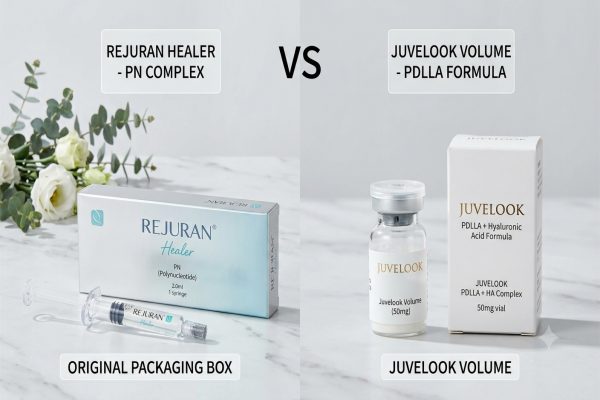
Juvelook vs Rejuran: Two Top-Tier Skin Boosters — What’s the Real Difference?
Ingredients: Salmon DNA vs PDLLA+HA
Rejuran is built around PN (Polynucleotide) — a long-chain DNA fragment extracted from salmon sperm, which shares over 98% homology with human DNA. PN stimulates fibroblast activity, boosts collagen production, and carries anti-inflammatory properties. Its core logic is repair — rebuilding damaged skin barriers so the skin can restore itself to a healthy baseline.
Juvelook contains 85% Poly-D,L-Lactic Acid (PDLLA) + non-crosslinked Hyaluronic Acid (HA). The PDLLA microspheres continuously activate fibroblasts in the dermis to stimulate new collagen and elastin production. HA provides immediate hydration and volume. Its core logic is regeneration + filling — HA handles the present, PDLLA builds the future.
Results Curve: Gradual vs Two-Phase
Rejuran delivers progressive repair. Two to four weeks after injection, PN continuously activates the skin’s self-repair capabilities — barrier function strengthens, redness fades, pores refine, and radiance improves. The change isn’t dramatic; it’s a quiet, steady improvement. After a full 3-session course, effects last 6 to 12 months.
Juvelook delivers a dual-phase curve. Phase one (immediate): HA instantly adsorbs water, giving the skin immediate plumpness and hydration. Phase two (long-term): PDLLA begins stimulating collagen 2 to 4 weeks post-injection, with skin firmness and elasticity continuing to improve. Results peak at 3 to 6 months and last 12 to 24 months after a full course. The key difference? Rejuran restores the present; Juvelook builds the future.
Ideal Candidates: Repair & Stabilize vs Contour & Lift
Rejuran is best for: seasonal sensitivity, redness, compromised barriers, unstable skin texture, and makeup that cakes or looks dull. It’s a foundational “inner repair” project — if your skin condition is compromised, Rejuran is almost always the safer starting point.
Juvelook is best for: pronounced nasolabial folds, hollow cheeks, deflated apple cheeks, downturned mouth corners, and overall sagging where you want lift without looking “filled.” It’s a combined “repair + refinement + support” approach. For those with sufficient budgets, the two can even be used sequentially — Rejuran first to restore the barrier, then Juvelook to refine contours.
Comparative Overview
| Dimension | Rejuran | Juvelook |
|---|---|---|
| Core Ingredients | PN (Polynucleotide) | 85% PDLLA + HA |
| Mechanism | Barrier repair, anti-inflammatory, skin stabilization | Collagen stimulation + immediate volume |
| Primary Effects | Texture refinement, pore reduction, dark circle improvement | Volume restoration, fine line reduction, lift, contour enhancement |
| Onset Pattern | Gradual, 2-4 weeks for visible improvement | Immediate HA effect + PDLLA onset at 2-4 weeks |
| Duration | 6-12 months | 12-24 months |
| Category | Repair-focused skin booster | Regenerative skin booster |
Pain & Recovery
Rejuran is notorious for discomfort, often described as “liquid fire” even with topical anesthetic. The high-viscosity formulation creates a distinct burning sensation during injection. The pain-reduced version (Red Box with lidocaine) helps, but the sensation remains noticeable.
Juvelook is comparatively gentler. Its formulation is designed to minimize irritation, and it’s often premixed with anesthetic. Patient feedback typically describes it as “a mild pressure sensation” — fully tolerable for most. Both produce post-injection papules (tiny bumps), which typically resolve within 1 to 3 days.
Price Reference (2026, Korea)
- Rejuran Healer 2cc: Hongdae ~149,000–275,000 KRW; Gangnam ~350,000–440,000 KRW
- Juvelook 1-2cc: Hongdae ~119,000–350,000 KRW; Gangnam ~400,000–800,000 KRW
Single-session prices may appear different, but when annualized — Juvelook lasts 12-24 months versus Rejuran’s 6-12 months — the monthly cost difference narrows significantly.
Can They Be Combined?
Yes, and many Korean clinics routinely combine them. Rejuran first to rebuild the foundation, then Juvelook to enhance contours. Together, they deliver simultaneous improvements in skin quality and structural definition — particularly effective for patients with both textural instability and volume loss. This combination protocol has become a standardized approach in many premium Korean dermatology centers.
In one sentence: Rejuran is “inner cultivation” — building skin health from within so it can glow on its own. Juvelook is “inner cultivation + structural support” — refining contours while the skin regenerates. The choice depends on whether your priority is stabilization or lift. If your barrier is compromised, start with Rejuran. If your skin is stable but showing early signs of hollowness and sagging, Juvelook offers superior long-term value.