C-Section Scar Repair: Complete Guide to Near-Invisible Results — Best Timing and Korean Repair Process Fully Explained
Postpartum Timing · Surgical Excision · Fractional Laser · PDRN Regeneration · Hospital Recommendations · Price Reference
After a C-section, that horizontal mark on the belly is a lingering concern for many mothers. Some say the scar will fade on its own and there is nothing to worry about; others tried laser only to find the color lightened but the raised texture remained — money spent with limited results. Faced with the same C-section scar, why does one person’s scar become nearly invisible while another’s becomes more and more noticeable over time? The difference is not in whether you treat it, but whether you choose the right 【timing】 and 【method】.
A C-section scar is not just a simple line — it involves three layers of concern: 【surface color, skin structure, and deep tension】. This article skips the basic theory and instead dives straight into the best timing for C-section scar repair, how to choose among Korea’s mainstream methods, what drives the price differences, and which hospitals do it well.
◎ The Three-Layer Problem of C-Section Scars — Color, Shape, Tension: All Three Matter
The reason C-section scars are difficult to treat is that the problem is not single-layered. Many mothers only see the “dark color” or the “raised texture,” but Korean doctors break the scar down into three layers for evaluation.
【Layer One: Surface Color.】 This includes redness, darkening, and hyperpigmentation. This can be addressed with lasers — fractional laser can break down scar fibrosis and stimulate collagen regeneration, reshaping the skin surface like resurfacing.
【Layer Two: Skin Structure.】 Is the scar depressed or raised? Hypertrophic scars become raised and hard, while atrophic scars look like a piece has been scooped out. Structural issues are hard to resolve with laser alone and require surgical excision of the old scar tissue, followed by precise re-suturing.
【Layer Three: Deep Tension.】 This is the most overlooked factor. The C-section incision is on the abdomen, and daily activities like standing, bending, and carrying a child create continuous lateral tension on the scar. If tension is not addressed, even after cutting out the old scar, the new scar will be stretched wide and become hypertrophic again.
When treating C-section scars, Korean doctors follow this repair logic: 【Use laser when possible to avoid the scalpel; when surgery is necessary, always pair it with tension management】. Those who only do laser can only address “color”; those who only do excision address “shape” but risk recurrence; those who pursue comprehensive repair are the ones who get closest to “invisible.”
◎ The Golden Window for C-Section Scar Repair — When Is the Best Time After Delivery
The timing of C-section scar repair directly affects the final result. This is the question mothers care about most — 【”When should I start treatment?”】
【0-7 Days Post-Op (Inflammatory Phase):】 The wound is red, swollen, and painful; the body is working on hemostasis and fighting infection. The focus at this stage is not “repair” but “protection” — keep the area clean and dry, avoid pulling on the wound.
【1 Week – 3 Months Post-Op (Proliferative Phase):】 This is the most critical stage and the reason many people’s “scars become noticeable.” The body is producing collagen at a furious pace — if left uncontrolled, the scar will thicken, darken, become hard and itchy. Intervention should begin in this phase — use silicone gel/scar sheets, tension-reducing tape (to minimize pulling), and if necessary, laser or injection treatments. This phase determines whether the scar will be “faint” or “obvious” in the future.
【3-6 Months Post-Op (Remodeling Phase):】 The body starts “reorganizing” the tissue produced earlier; the scar gradually flattens, and the color shifts from red to pink then lighter. During this phase, laser can fade pigmentation, and microneedling/RF can improve texture.
【6 Months – 1+ Year Post-Op (Maturation Phase):】 The scar is essentially set and will not change on its own. If you are not satisfied, only surgical repair, regenerative treatments, or combined aesthetic procedures can alter it.
【Consensus among Korean dermatologists:】 After a C-section, scar treatment can generally begin 【around 6-8 weeks postpartum】. It is recommended to start intervention before the scar becomes hard or noticeably raised. The earlier the intervention, the easier the repair, the better the result, and the lower the cost.
◎ Mainstream Korean Repair Methods — Surgical Excision, Laser, Injections: How to Choose
【Surgical Excision + Precision Suturing (For hypertrophic, raised, and old scars)】
For hypertrophic scars or keloids, the typical approach is to excise the old scar tissue and re-suture. Korean doctors call surgical scar revision “precision suturing” — the emphasis is not on “cutting” but on “sewing.”
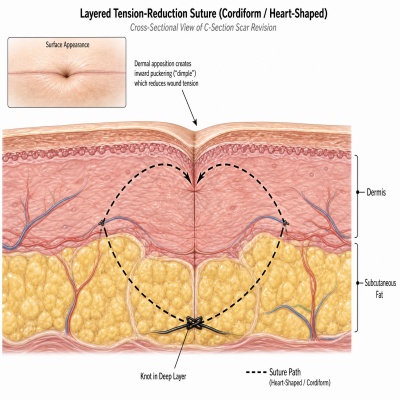
【Basic Suturing】 simply aligns the skin edges; tension during wound healing causes the scar to widen easily and become hypertrophic. 【Tension-Reducing Precision Suturing】 uses layered suturing technique — from the deep fascia to the dermis to the epidermis, tension is reduced layer by layer. The deep layer uses absorbable sutures to bring the tissue together, and the superficial layer uses ultra-fine sutures for precise alignment. There is virtually no tension pulling on the wound during healing.
Dr.hams Plastic Surgery is renowned for its 【Z/W-plasty scar revision technique】, and for complex cases employs 【fusiform excision with local flap grafting】, forming a combined “surgical + non-surgical” treatment system. For C-section scars, the approach is: first surgically excise the hypertrophic tissue, then use laser to fade pigmentation, and finally use microneedling to stimulate collagen regeneration.
Anseongryeol Plastic Surgery has innovated a 【Trauma Repair System】 using a staged excision approach for large scars — 1-3 sessions of removal based on the scar condition, with 3-6 months between each session. The head surgeon insists on performing 【precision surgery under a microscope】 to achieve optimal suture results.
【Fractional Laser (For deep discoloration and uneven surface)】
Fractional laser (such as CO2 laser) excels at treating acne scars or C-section scars, breaking down scar fibrosis and stimulating collagen regeneration. However, strict sun protection is essential after laser treatment; otherwise, pigmentation will become more pronounced. Starting laser 【1 month】 after surgical repair, once per month for 3-4 sessions, can enhance results by 【70%】.
Lowell Plastic Surgery, after scar excision surgery, uses dedicated scar laser equipment for scar improvement treatment and also performs 【PDRN regenerative injections】 to aid cell regeneration and tissue recovery.
【Injection Therapy (For mild raised scars without adhesions)】
When the scar is not severely raised and has no adhesions to surrounding tissue, injection therapy may be considered. Typically 1-3 sessions are needed. However, for keloids, 【a single injection approach is not recommended】, as it can easily provoke the keloid to grow larger. The lesion needs to be cleared through ultra-precise surgical excision, combined with preventive measures such as 【SRT-100 superficial radiotherapy】.
◎ Recommended Hospitals for C-Section Scar Repair in Korea
Lesarts Plastic Surgery
⏰ Seoul Gangnam · C-section Scar Repair Specialty
Per-centimeter pricing · Standalone procedure
C-section scar repair can be performed as a 【standalone surgery】 without needing simultaneous abdominoplasty. Pricing is by scar length at a standard rate of 【200,000 KRW per centimeter】 (before tax). For hypertrophic or keloid-type scars, the approach is excision of old scar tissue and re-suturing. Final price must be confirmed after consultation.
Reference price: 200,000 KRW per centimeter
Dr.hams Plastic Surgery
⏰ Seoul Gangnam · Scar Repair Center
Z/W-plasty scar revision · Surgery + Laser combined · 20 years of experience
Head surgeon Han Hee-jung holds a doctorate in plastic surgery and has focused on scars for over 【20 years】. Renowned for 【Z/W-plasty scar revision technique】, the approach for C-section scars uses 【surgical excision of hypertrophic tissue + laser pigmentation fading + microneedling collagen stimulation】 as a combined treatment system.
Reference price: Surgical excision with precision suturing starts from approximately 3,000 RMB; each additional 3cm in length adds approximately 800 RMB; C-section scar surgical repair starts from approximately 36,000 RMB.
Anseongryeol Plastic Surgery
⏰ 2F, Nonhyeon Building, 116 Dosan-daero, Gangnam-gu, Seoul
Dual specialty qualifications · Microscope precision suturing · Staged excision
Established in 1996, head surgeon An Seong-ryeol holds dual 【plastic surgery and dermatology qualifications】, with over 30,000 surgical cases and 50,000+ scar consultation experiences. Employs a 【staged excision approach for large scars】, removing in 1-3 sessions based on scar condition, with 3-6 months between sessions. Insists on performing 【precision surgery under a microscope】. C-section scar surgical repair starts from approximately 【39,000 RMB】.
Lowell Plastic Surgery
⏰ 121 Teheran-ro, Gangnam-gu, Seoul
Excision + Laser · PDRN regenerative injections
Removes the scar itself through 【excision of the scarred area followed by suturing】; post-operatively uses dedicated laser equipment for improvement treatment, along with 【PDRN regenerative injections】 to aid cell regeneration and tissue recovery. Scar removal surgery at 【33,000 KRW per 1cm】; scar laser 3 sessions at 【240,000 KRW】 (billed separately), including VAT, anesthesia fee, and post-operative care.
BTN Dermatology
⏰ Seocho-gu, Seoul
Subcision · Combined treatment
Specializes in acne scars, acne marks, and scar repair. Scar treatment starts with determining “whether you are suitable and which approach fits” — those suitable for systematic repair include surgical scars (C-section, post-operative). Uses 【subcision + fractional laser + regenerative injections】 as a multi-modality synergistic treatment.
The First Dermatology
⏰ Busan and Seoul
7 specialist doctors · 60 devices
Has 【7 board-certified dermatologists and 60 international top-tier devices】; UltraPulse CO2 fractional laser is one of the “gold standard” devices for scar treatment in Korea.
Reference price: UltraPulse CO2 fractional laser single session approximately 300,000-600,000 KRW
◎ C-Section Scar Repair Price Reference
| Treatment Method | Reference Price |
|---|---|
| Lesarts Surgical Excision | 200,000 KRW/cm (before tax) |
| Dr.hams Surgical Excision | Starting from approximately 3,000 RMB; +800 RMB per extra 3cm |
| Dr.hams C-Section Surgical Repair | Starting from approximately 36,000 RMB |
| Anseongryeol C-Section Surgical Repair | Starting from approximately 39,000 RMB |
| Lowell Scar Excision | 33,000 KRW/cm |
| Lowell Scar Laser (3 sessions) | 240,000 KRW |
| Dr.hams Laser Scar Treatment | Starting from approximately 1,200 RMB/session |
【Korea vs Southeast Asia:】 C-section scar surgical repair in Korea starts from approximately 36,000-39,000 RMB, while similar procedures in Singapore typically range from SGD 4,000-8,000 (approximately 21,000-43,000 RMB) — the price gap is not particularly large. However, Korea does have an edge in technical expertise and density of specialized hospitals in the scar repair field, especially the combined treatment system of surgery + laser + regenerative injections.
◎ Surgical Scar Repair vs Laser Scar Treatment — Understanding the Difference in “Depth”
This is a question many mothers struggle with. Surgery and laser are not an “either/or” choice — they are different tools for different depths.
- 【Choose surgery when:】 The scar is clearly raised (hypertrophic scar or keloid); C-section scar is old and has a prominent linear appearance; the scar is accompanied by adhesions or pulling sensations.
- 【Choose laser when:】 The scar is deeply discolored (red, dark, hyperpigmented); the scar surface is uneven but not severely raised; as a post-surgical adjunct to smooth and even out the surface.
- 【Choose both when:】 Korean doctors frequently use 【surgery + laser combined treatment】 — surgically excise deep scar tissue with precision suturing, then one month post-op use laser to smooth surface texture and color. Surgery solves the “shape” problem; laser solves the “color” problem; the two are complementary. Dr.hams’ typical approach for C-section scars is: first surgically excise hypertrophic tissue, then use laser to fade pigmentation, and finally microneedling to stimulate collagen regeneration.
C-section scar repair is not a question of “whether it is possible” — it is about “which repair logic you choose.” Color can be lightened; raised areas can be flattened; depressions can be filled; lines can be made thinner. But 【”complete disappearance” is not realistic; “nearly invisible” is achievable】. How close you can get depends on the technique, scar type, and intervention timing.
If you are willing to accept a combined surgery + laser protocol and commit to 3-6 months of post-operative tension management, C-section scar repair will most likely leave you satisfied. But if you are hoping for a “one-time fix” and cannot accept any recovery period, it may not be for you. The consensus among Korean dermatologists is: 【Beginning intervention 6-8 weeks postpartum is the golden window for the best results at the lowest cost.】
— This article is written based on an in-depth medical aesthetics analysis framework, with Korean factors naturally integrated as a reference system —