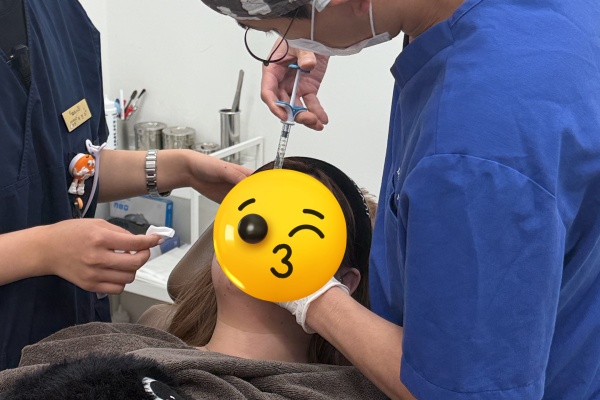
The Other Side of Aegyo-sal Injection: Side Effects, Recovery, and Failure Cases — Read This Before You Get It Done
Aegyo-sal in Korean is called 【aegyo-sal】 — “flirtatious flesh.” One milliliter of hyaluronic acid injected at the right position can transform your gaze from “cold” to “warm,” making you look more approachable.
But that’s when it’s “done right.” Aegyo-sal injection has one of the highest failure rates among all facial injection procedures. The eye area is one of the most sensitive regions of the face — dense blood vessels, thin skin, frequent muscle activity. The same dosage, the same material — a 1mm difference separates “naturally-born” from “sad frog.”
This article focuses on aegyo-sal injection risks and recovery, helping you understand what’s normal, what signals failure, and what to do when things go wrong.
The Most Common Failure Types
【Unnatural shape — HA becomes a “caterpillar”】
This is the most common problem. After injection, a clearly defined cord-like ridge appears, especially obvious when smiling. Two causes: 【wrong injection depth】 — HA wasn’t placed at the orbicularis superficial layer but in the more superficial subcutaneous layer; and 【excessive dosage】 — exceeding 0.5ml per side. The orbicularis is a dynamic muscle; HA must “follow the muscle” at the superficial layer. Once injected at the wrong depth, it becomes a stiff cord when smiling.
【Aegyo-sal becomes eye bags — downward displacement or spreading】
Aegyo-sal and eye bags are separated by a fine line. If the injection position is too low, or HA spreads, the aegyo-sal becomes “eye bags.” The gold standard Korean doctors use: directly below the pupil, 3-5mm from the lower eyelid margin, visible when smiling, basically invisible when not.
【Asymmetry — obvious difference between sides】
Unilateral dosage deviation or different injection depths can cause asymmetry. For Asians, a natural aegyo-sal length is 7-9mm; over 10mm looks fake.
【Transparency and blue tint — wrong material choice】
HA has some light-transmitting properties. In the very thin under-eye area, if regular HA is used or dosage is large, a blue-green “Tyndall effect” appears in sunlight. Aegyo-sal should use small-molecule, low-cross-linked HA, not large-molecule fillers.
【Hardening or lumps — uneven injection】
HA forms small hard lumps under the skin, felt as granularity. Usually caused by uneven injection or excessive single-point volume, requiring hyaluronidase treatment.
Who Is Not Suitable for Aegyo-sal Injection
- 【People with prominent eye bags】 — adding aegyo-sal makes eye bags more noticeable
- 【People with loose lower eyelid skin】 — HA injection may worsen the laxity appearance
- 【People with severe dark circles】 — aegyo-sal injection can’t improve dark circles and may make them more obvious
- 【People with recurrent periorbital edema】 — HA may worsen morning puffiness
Recovery Timeline: Each Stage Is Normal, But Stay Alert
【Day of injection (0-24 hours)】
Mild redness, swelling, and warmth at injection sites with tiny needle marks. Apply 【ice packs】, 10-15 minutes at a time, intermittently. Never rub or press the injection area. No makeup on the same day.
【Days 1-3 (acute reaction period)】
Redness gradually subsides, but mild swelling or foreign body sensation may persist. Some experience slight bruising. Continue ice packs, avoid strenuous exercise. If redness, swelling, or pain progressively worsens, watch for infection.
【Days 4-7 (de-swelling period)】
Most swelling and bruising subside, aegyo-sal shape begins to look natural. If obvious lumps or hard masses remain, there may be dosage or depth issues.
【Days 7-14 (stabilization period)】
Results basically stable, injection area integrates better with your own tissue. This is when you can judge whether the aegyo-sal shape is ideal.
【1 month post-op】 — Fully stable, fine-tuning possible.
【Duration】 — Korean HA lasts about 6-12 months; imported premium brands about 12-18 months.
When to Consider Treatment After Injection
A botched HA injection doesn’t mean “permanently ruined” — as long as the material is fine and there’s no infection, it’s reversible.
Main treatment: 【hyaluronidase】 to dissolve the HA. It breaks down HA within 24-48 hours, restoring the filled area to its original state. Days 3-5 are the observation period; decide whether to treat after the shape stabilizes. If you notice unnatural shape, asymmetry, or blue transparency, don’t “wait and see” — earlier treatment means faster recovery.
After dissolution, temporary mild hollowing or unevenness may occur, naturally recovering within weeks to a month.
Final Reminders
Aegyo-sal injection recovery typically takes 1-2 weeks to look natural, but the shape dynamically adjusts with facial expressions. If you feel it’s “not quite natural,” 【wait two weeks before concluding】 — by then, all swelling has subsided, revealing the final result.
But three things shouldn’t be “waited out”: progressively worsening redness, swelling, heat, and pain (possible infection); obvious shape abnormalities (position too low like eye bags); progressively worsening bruising or hematoma. If these occur, see your doctor promptly.
If you’re considering aegyo-sal injection, during consultation ask what HA brand is used, how the injection depth is designed, and how dosage is distributed. A doctor who can clearly explain the treatment logic, risks, and possible unsatisfactory outcomes is more trustworthy than one who only guarantees “it’ll look great.”
Disclaimer: This article is compiled from public sources for reference only. Specific treatment plans and costs should be based on professional doctor consultation. This article does not constitute medical advice.