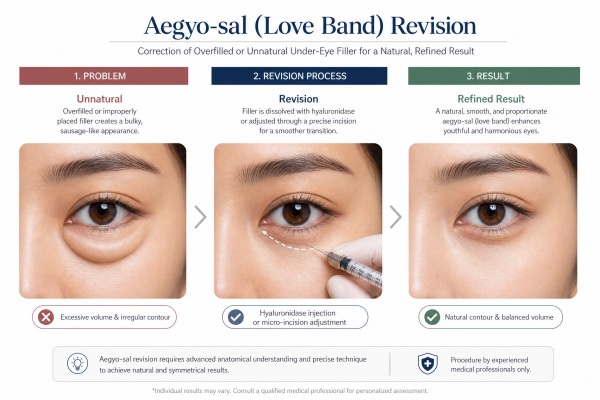
What to Do When Aegyo-sal Goes Wrong in Korea: From Gangnam Dermatology to Dissolution Repair — A Complete Rescue Guide
Aegyo-sal injection isn’t new in Korea. Nearly every dermatology clinic in Gangnam’s Apgujeong and Cheongdam areas performs it. Many Southeast Asian women fly in specifically for that one milliliter of HA to make their smile gentler and more approachable.
But aegyo-sal injection has always had one of the highest failure rates among facial injections. The eye area is extremely sensitive — dense blood vessels, thin skin, frequent muscle activity. The same dosage, the same material — a 1mm difference separates “naturally-born” from “sad frog.”
Many discover problems after returning home from Korea, only to find local doctors don’t know how to handle it — or make it worse. This article covers how to repair botched aegyo-sal injections from Korea, for those who’ve had it done or are planning to visit Korea.
Most Common Failure Types from Korean Aegyo-sal Injections
Korean doctors share unified aesthetic standards for aegyo-sal, but technical skill gaps exist. These are the most common repair case types seen in Korean dermatology clinics.
【Cord-like ridge — “Caterpillar” phenomenon】
The aegyo-sal becomes a clearly defined, stiff “strip of flesh,” especially obvious when smiling. On Korean plastic surgery forums, this is the most common type of aegyo-sal failure. Cause: injection too superficial — not placed at the orbicularis superficial layer but accumulated more superficially; or excessive single-point volume. Korean repair doctors use ultrasound to confirm HA distribution before precise dissolution.
【Aegyo-sal displacement — becoming eye bags】
The aegyo-sal disappears, replaced by a lower-positioned bulge that looks like eye bags when smiling. Cause: injection position too low, or HA migrating downward due to gravity. In Korea, this is classified separately as “dark circle worsening” type failure, because the shadow from displacement makes dark circles more visible. Treatment typically involves dissolution and re-injection, with tear trough ligament position marked beforehand to avoid injury.
【Transparency and blue tint — Tyndall effect】
In sunlight or bright light, a blue-green halo appears under the eye. This is from using the wrong material — the aegyo-sal area should use small-molecule, low-cross-linked HA. If large-molecule or high-cross-linked products are used, light scatters through the thin under-eye skin. Korean repair doctors first ask: “What brand was used? Who injected it?” — this directly determines the repair plan and expected outcome.
The Real Problem Is Often “After-Sales Service”
After aegyo-sal injection, minor shifting may occur within 1-2 weeks due to muscle dynamics and tissue edema. In Korea, you can return to the clinic anytime for fine-tuning — this is standard service at Seoul dermatology clinics. But for Southeast Asian tourists, this is nearly impossible.
After flying back to Manila, Bangkok, or Singapore, if you notice asymmetry or slight over-filling, local doctors often hesitate to treat. They don’t know what product was used, and hyaluronidase concentrations and methods vary by country — rash treatment carries high risk.
Korean repair clinics typically do three things: 【confirm injected brand and dosage】 (through medical records); 【use ultrasound to locate HA position】; 【provide a combined dissolution + readjustment plan】. The last step only starts once hyaluronidase is available.
Korean Repair Logic: Check Material First, Then Plan
In Gangnam aegyo-sal repair, doctors follow this decision path.
【HA-filled aegyo-sal — Hyaluronidase is first choice, dissolve + fine-tune simultaneously】
Standard Korean approach: ultrasound first to confirm HA distribution and depth; inject hyaluronidase with ultra-fine needles; observe shape changes on the spot, fine-tune with precise re-injection if needed. Dissolution takes minutes; HA breaks down within 24-48 hours. Temporary mild hollowing may occur, naturally recovering in 1-2 weeks.
【Autologous fat-filled aegyo-sal — Korean doctors’ least favorite case】
Once fat survives, it’s your own tissue — no drug can dissolve it. Korean doctors are reluctant to take on these repairs because “touching it might not make it better.” If problems are severe, options include secondary fat grafting fine-tuning or laser lipolysis. More serious cases require surgical removal.
【ADM artificial dermis implant — Surgical sequelae repair】
ADM has already integrated with tissue and can’t be dissolved. Unnatural shape requires surgical removal or readjustment, and must wait 3-6 months after initial surgery for tissue to fully stabilize.
Complete Timeline for Aegyo-sal Repair in Korea
【Immediate post-op concerns】: If something seems wrong right after the procedure, most Korean clinics advise waiting 1 week. Peak swelling is in the first 3 days; judging too early is inaccurate. But if the position is obviously too low or severely asymmetric, contact the clinic for a follow-up at 3-5 days — this is common practice in Korea, not “bothering the doctor.”
【1-2 weeks post-op】: Shape basically stable. If unsatisfied, Korean doctors recommend early treatment — don’t delay, as HA may spread or adhere to tissue, increasing repair difficulty.
【3 weeks post-op】: The best repair window. All swelling has subsided; dissolution and re-injection can be done simultaneously, completing within 1-2 weeks.
Recovery and Precautions After Repair
- 【Days 1-3】: Mild redness and swelling, mainly ice packs. Avoid rubbing.
- 【1 week】: Swelling subsides, results basically visible.
- 【2 weeks】: Shape basically stable.
- 【Repair restrictions】: Avoid strenuous exercise, sauna, alcohol; don’t press or rub the injection area; keep clean.
【Tips for Southeast Asian patients getting aegyo-sal in Korea:】
- 【Don’t just look at price.】 Some Hongdae clinics charge 70-80K KRW for aegyo-sal, while Gangnam premium clinics charge 400K+. The difference is the doctor’s understanding of periorbital anatomy and ability to handle complications.
- 【Don’t rush to fly home after injection.】 Stay in Korea at least 7-10 days. Return to the clinic at 3-5 days for a follow-up so the doctor can check the shape and fine-tune immediately if needed.
- 【Ask about the injection brand during consultation.】 Get injection records so if problems arise back home, local doctors can treat more effectively.
- 【Bookmark a few Gangnam repair clinics.】 Do your homework before traveling — know who to contact if needed.
Aegyo-sal repair success rate is much lower than initial injection because it involves both “correction” and “reshaping.” In Korea, good repair doctors don’t just “remove” — they reshape based on remaining material, which is far harder than getting it right the first time.
Disclaimer: This article is compiled from public sources for reference only. Specific repair plans should be based on Korean professional doctor consultation. This article does not constitute medical advice or a recommendation for any clinic or doctor.