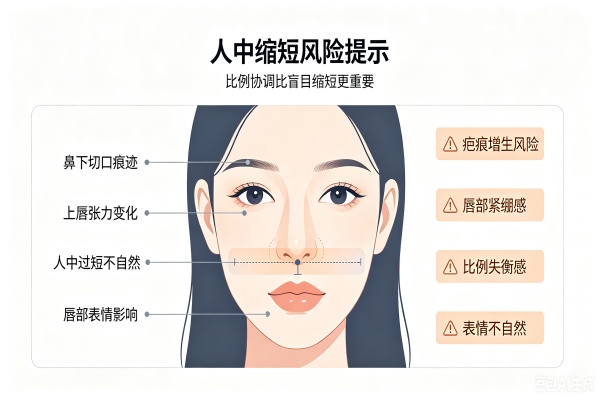
The ‘Risk Map’ of Philtrum Shortening: Scarring, Retraction, Stiff Expression — Problems at Each Post-Op Stage and How to Handle Them
Philtrum shortening is called “the most cost-effective anti-aging procedure” in Korea, but risks do exist. Incision scarring, rapid retraction, upper lip eversion, expression stiffness, asymmetry — these issues all have real post-op feedback online.
This article covers risks from three dimensions: 【risk types, problems at each post-op stage, and must-know pre-op precautions.】
Five Major Risk Types
【1. Scar hypertrophy — the core risk】
The philtrum area has thin skin, frequent expression activity, and high healing tension — these three factors combined make incision healing the surgery’s biggest variable. Even with excellent suturing, some degree of scarring exists. The difference: good doctors control scars to “almost invisible at social distance,” while inexperienced doctors may leave obvious hypertrophic scars.
【GD Plastic Surgery】‘s Dr. Song Sang-hoon addresses this with his “Four-Layer Tension-Reduction Suturing System” — deep muscle precise alignment, subcutaneous tension-reduction, dermal invisible suturing, and epidermal tension-free closure — four layers of progressive tension reduction. 【Avant Plastic Surgery】‘s Dr. Lee Hyun-jik uses third-generation philtrum shortening, not excising nostril sill structures, with 0.77mm ultra-fine sutures.
Those with severe keloid history should not undergo this surgery — subnasal incisions have a very high probability of hypertrophic scarring. If post-op hypertrophic scars develop, secondary surgery or laser/medication treatment may be needed.
【2. Rapid retraction】
Philtrum shortening has about 【30% retraction rate.】 The upper lip looks more upturned initially, with final results stabilizing after 1-3 months. If retraction wasn’t factored in pre-op, or insufficient skin was removed, results may noticeably weaken at 3-6 months.
【3. Upper lip eversion or incomplete closure】
Excessive skin removal can cause upper lip eversion — lips can’t close naturally at rest, affecting daily function. Main cause: inexperienced doctors misjudging the “shortening amount.” Forcing excessive shortening with a low nasal base doubles eversion risk.
【4. Expression stiffness and philtrum ridge asymmetry】
Improper orbicularis oris handling can limit upper lip movement during speech or smiling, causing unnatural expressions. Asymmetric suturing on left and right sides can cause philtrum ridge deviation.
【5. Infection or hematoma】
Improper post-op care may cause infection — redness, swelling, heat, pain, and increased discharge at the incision. Post-op bleeding forming hematoma may lead to poor healing.
Problems at Each Post-Op Stage
【Days 1-3: Swelling period】
The most easily misjudged stage as “failure.” The upper lip is visibly swollen, the philtrum may look longer than pre-op, with minor oozing and pain around the incision. This is normal — no need for anxiety. But if 【severe pain, heavy bleeding, or fever】 occurs, watch for infection or hematoma.
【1 week: Suture removal period】
After suture removal, the incision is clearly visible. Visible suture marks, obvious tightness or slight eversion of the upper lip are normal at this stage. But if 【obvious bilateral asymmetry or noticeably crooked philtrum】 is found, confirm with the doctor whether it’s a suturing technique issue. Redness and slight discharge around the incision are normal, typically subsiding 3-5 days after suture removal.
【Weeks 2-4: Scar formation period】
The incision enters the proliferation phase — color turns red, slight raised feeling. This is normal healing, not a “botched job.” 【GD Plastic Surgery】‘s four-layer suturing patients have nearly invisible incisions at this stage; with ordinary suturing, scars may already be very obvious.
Upper lip tightness and slight pulling sensation persist — feeling unnatural when talking or smiling is normal, as deep muscles haven’t fully adapted to the new position.
【Months 1-3: Result stabilization period】
This stage determines surgical success or failure. Retraction is basically complete; final results appear. If retraction exceeds expectations, upper lip eversion hasn’t subsided, scars remain very obvious, or philtrum ridge asymmetry persists — these problems are basically set at this stage and require secondary repair.
【Months 3-6: Scar softening period】
Scars gradually soften and fade. If the incision is still an obviously raised red scar at this stage, hypertrophic scarring may be present — timely intervention needed (laser, medication injection). Upper lip numbness basically subsides; expression naturalness recovers.
Must-Know Pre-Op Precautions
- 【Those with keloid history should not undergo this surgery】 — subnasal incisions have extremely high probability of hypertrophic scarring that continues to grow.
- 【Consider the order with rhinoplasty】 — Korean doctors typically recommend 【rhinoplasty first (especially tip refinement), then philtrum shortening】 to avoid worsened nostril show. Confirm the order during consultation if planning both.
- 【Stop anticoagulants 2 weeks before】 — including aspirin, vitamin E, fish oil, ginseng, and other supplements, to reduce intra-operative bleeding and post-op hematoma risk.
- 【Fast for 8 hours before surgery】 — basic requirement for general or sleep anesthesia.
- 【Understand your “retraction rate”】 — confirm with the doctor whether the planned shortening accounts for 30% retraction. Different people have different retraction degrees; experienced doctors estimate your retraction range during consultation.
Post-Op Care Guide
【Within 1 week】: Cold liquid diet (no straws), avoid exaggerated expressions, minimize talking, avoid laughing and forceful yawning. Keep incision clean and dry; sleep with elevated pillow to reduce swelling.
【After suture removal (7 days)】: Begin scar ointment (silicone gel type), continue for 3-6 months. Avoid makeup for at least 1 week after suture removal, especially lip and nasal base areas.
【Within 1 month】: No smoking, alcohol, or spicy food; avoid strenuous exercise, sauna, and steam rooms.
【Months 2-3】: Tightness when moving lips or smiling is normal. Continue scar management; if hypertrophic scarring is obvious, follow up promptly.
【6 months】: If scars remain obvious, contact the doctor for laser or medication assessment. Upper lip numbness should be gradually recovering. If significant discomfort persists, consult a professional doctor.
Philtrum shortening risks are real, but most can be effectively managed by experienced doctors. Pre-op understanding, choosing a reliable doctor, and strict post-op compliance are the most effective risk-reduction strategies. When considering this surgery in Korea, focusing on the doctor’s scar management approach and cases is far more important than price.
Disclaimer: This article is compiled from public sources and industry reports for reference only. Specific risks and management plans should be based on professional doctor consultation. This article does not constitute medical advice or a recommendation for any clinic or doctor.