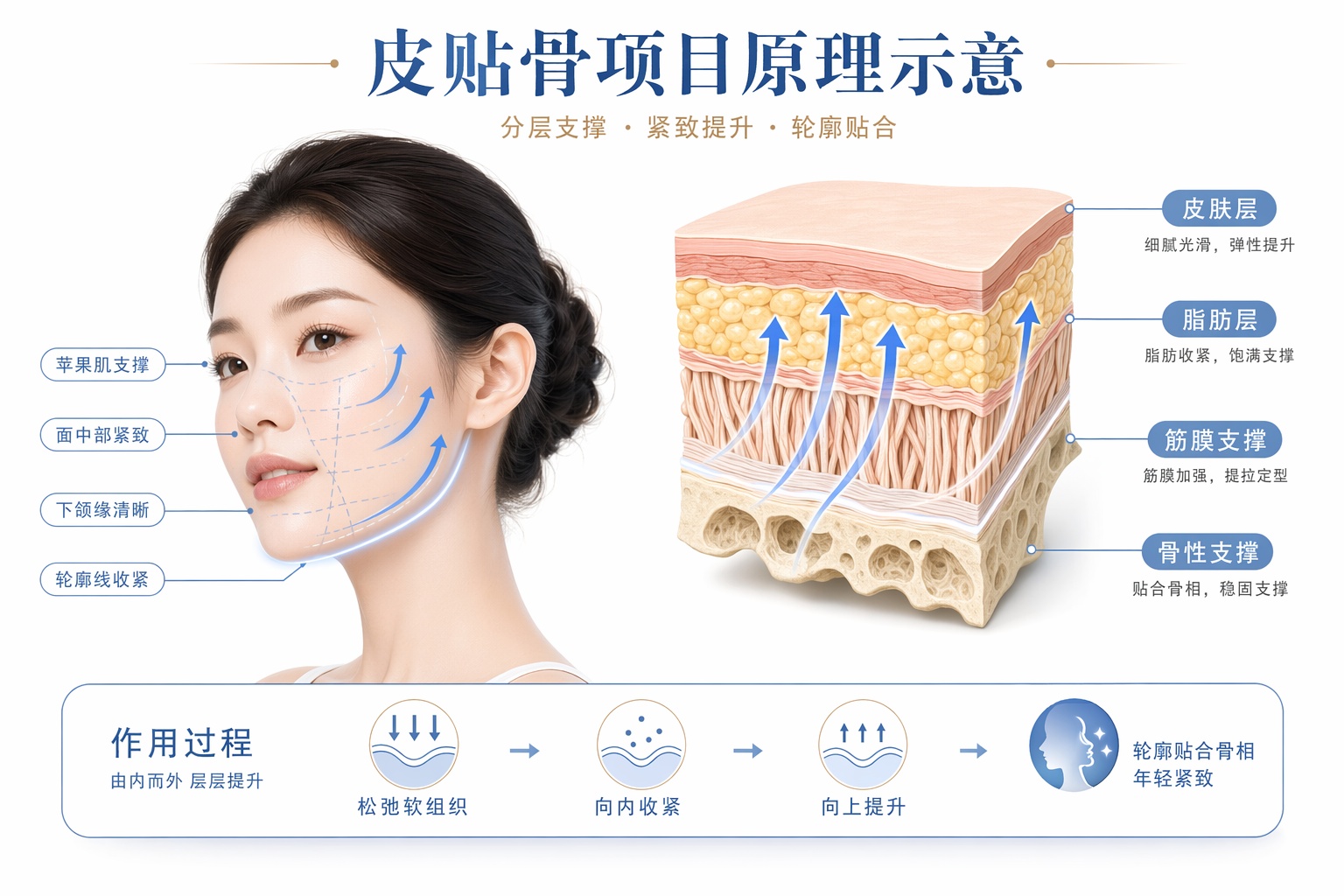
What Is ‘Skin-to-Bone’? How Korean Doctors Create Contoured, Non-Puffy Faces
“Skin-to-bone” has become increasingly popular in medical aesthetics discussions. It’s seen as synonymous with “high-end face” — sharp contours, soft tissue closely hugging the bone structure, looking better without anyone being able to tell what changed.
But many have a vague understanding of this concept. Some think “skin-to-bone” just means being thin; others think it’s a specific surgery. It actually describes a 【facial state】 — skin, soft tissue, and bone tightly fitted, with clear contours, natural expressions, and no excess puffiness.
What Is “Skin-to-Bone” — Clarifying the Concept
【”Skin-to-bone” is not a surgical name — it’s an aesthetic state.】
Simply put: facial soft tissue tightly following bone contours, without excess puffiness or sagging. Specifically:
- 【Zygomatic area】 — clear zygomatic high point, apple cheeks neither sagging nor over-filled
- 【Jawline】 — clean lines, no double chin or soft tissue accumulation
- 【Mid-face】 — shallow nasolabial folds, no obvious hollowing or over-filling in cheeks
- 【Overall state】 — contoured when not smiling, natural expression when smiling
This state is sought after because aesthetics is shifting from “addition aesthetics” — filling wherever there’s hollowing, pursuing fullness — to 【”structural aesthetics”】: clear contours, tight soft tissue, strong bone structure. Compared to the often-mentioned “puffy face” — over-filled, bloated and blurred tissue — “skin-to-bone” pursues “just-right tightness.”
【Key insight】: Market so-called “skin-to-bone” methods are essentially known tightening and lifting procedures — fascia lifting, facelift, thread lifting — with more vivid packaging, not radically new technology.
Three-Layer Logic for Achieving “Skin-to-Bone”
Truly effective “skin-to-bone” surgical plans typically involve three layers.
【Layer 1: Periosteum — rebuilding the “foundation”】
Deep support at the periosteum layer, like building “load-bearing walls” for the face. Common materials: CaHA (calcium hydroxylapatite), large-molecule HA (like Juvéderm Voluma). Injected at the periosteum to form support points, lifting sagging soft tissue. This layer addresses the root cause of “soft tissue falling.”
【Layer 2: SMAS fascia — lifting the “skin-muscle burden”】
The SMAS layer is the face’s “load-bearing wall” — once lax, it drags the skin down, causing nasolabial folds, mouth corner drooping, and blurred jawline. “Skin-to-bone” lifting performs 【”folding repositioning”】 on the SMAS — doctors find the lax fascia through minimal incisions, fold and tighten the excess like “folding a blanket,” then fix it. This is currently Korea’s most long-lasting method for “skin-to-bone” results.
【Layer 3: Dermis — stimulating collagen, improving skin quality】
Gentle dermal stimulation activates fibroblasts to synthesize new collagen and elastin, making skin more elastic and reducing fine lines. This step is the finishing touch — adding “tenderness” beyond “tightness.”
How Korea Does “Skin-to-Bone” — Korea vs China Technical Routes
Korea’s approach to “skin-to-bone” follows 【”minimally invasive precision, natural invisibility.”】 Two core directions:
【Mesh threading technique】: 8 different angles of thread insertion form a dense support network under the skin. Seoul’s mainstream layered threading is typical. Suitable for mild to moderate laxity, fast recovery, minimal marks.
【Liquid regeneration stimulation】: Injection products precisely target lax areas,主打 “zero recovery, natural tightness.” More suitable for mild laxity in younger patients, using regenerative materials (like PLLA, PDLLA) to stimulate autologous collagen.
The 【Chinese route】 emphasizes “overall intervention, layered effectiveness” — combining physical thread lifting with regenerative material collagen stimulation, more suited to Asian faces with thicker soft tissue prone to overall sagging.
Neither route is absolutely superior — the key is which logic suits your facial base better.
Korean Procedures That Create “Skin-to-Bone”
【SMAS Lift (Mid-face Lift)】
Targets the deep support structure — the SMAS layer. Korean doctors generally believe facial sagging’s root cause is in the SMAS layer; separating skin and fascia first, then lifting multiple layers simultaneously, is effective. Suitable for ages 40-60 with moderate to severe sagging.
【Deep Plane Facelift】
Lifts skin and deep fascia (SMAS) as a single unit. Releases ligaments that weaken with age, significantly improving mid-face, jawline, and neck sagging. More lasting and natural than traditional methods because it addresses aging’s root cause.
【Ultraformer / Ultherapy】
Non-invasive lifting using high-intensity focused ultrasound on the SMAS layer. Suitable for mild laxity without surgery. Results gradually appear over 2-3 months.
【Thread Lifting (PDO/PLLA)】
Absorbable threads provide physical lifting and collagen stimulation. Suitable for ages 30-50 with mild to moderate sagging. Korean MINT threads and PLLA threads are common choices.
【Contour Fixation (Periosteum Injection)】
Large-molecule HA or regenerative materials injected at zygomatic, jaw angle, and brow ridge support points to rebuild bone structure support. Suitable for ages 30-45 with early sagging.
Price Reference
| Procedure Type | Reference Price (KRW) | Approximate (RMB) |
|---|---|---|
| Contour fixation (periosteum injection) | 2M-4M | ~11,000-22,000 |
| Thread lifting (full face) | 1.5M-3M | ~8,000-16,000 |
| Ultherapy/Ultraformer (full face) | 1M-2.5M | ~5,300-13,000 |
| SMAS mid-face lift | 4M-8M | ~21,000-42,000 |
| Deep Plane facelift | 8M-15M | ~42,000-80,000 |
| —— | ||
| Final pricing subject to clinic consultation. |
Who Is Suitable and Who Isn’t
【Suitable:】
- 【Puffy face (fat accumulation)】 — needs fat reduction + skin tightening; fiber lipolysis or liposuction is a prerequisite
- 【Saggy face (collagen loss)】 — needs direct collagen supplementation or stimulation
- 【Drooping face (ligament/fascia laxity)】 — needs ligament support and fascia repositioning; SMAS lift is the answer
- 【Over-filled face】 — needs dissolution of excess fillers, then tissue tightening, ligament lifting, and bone remodeling
【Not suitable:】
- Those already in “skin-to-bone” state with little facial fat — limited improvement potential
- Those with low recovery tolerance who don’t want swelling — surgical procedures have longer recovery
- Those with limited budget seeking “one solution” — true “skin-to-bone” often requires 2-3 combined procedures
“Skin-to-bone” isn’t achievable with a single procedure. It requires combining 2-3 approaches based on your facial base — fat thickness, fascia laxity, bone structure — for layered, phased results. In Korea, truly good doctors don’t say “do this procedure for skin-to-bone” — they first determine whether your face is “puffy,” “saggy,” “drooping,” or “over-filled,” then provide corresponding combinations. A doctor who can explain the logic is more trustworthy than one who only says “it’ll tighten up after.”
Disclaimer: This article is compiled from public sources for reference only. Specific treatment plans and costs should be based on professional doctor consultation. This article does not constitute medical advice or a recommendation for any clinic or doctor.