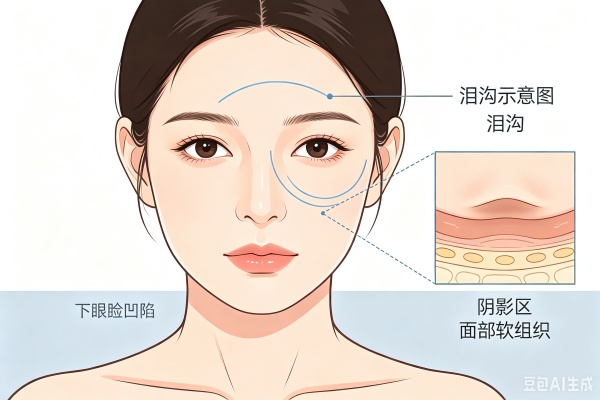
What Are Tear Troughs? The Hidden Source of Under-Eye Tiredness
Have you ever experienced this: you slept enough, but someone still asks “did you not rest well?” You layer concealer again and again, but those two grooves under your eyes remain visible?
This might not be dark circles or eye bags — it’s the 【tear trough】.
What Do Tear Troughs Look Like?
The tear trough is 【a depression extending from the inner eye corner along the lower eyelid toward the nose】, typically arc-shaped or diagonal, about 2cm long. It’s not a swelling but a groove — as if someone gently pressed an indentation under your eye.
Many confuse tear troughs with eye bags. Simply put: 【eye bags bulge outward, tear troughs indent inward】. Eye bags are protrusions from orbital fat herniation; tear troughs are depressions at the eyelid-cheek junction. They often coexist — the more prominent the eye bags, the deeper the tear troughs appear.
How Do Tear Troughs Form?
Tear trough formation involves 【both congenital and acquired factors】.
【Congenital factors:】 Below the tear trough lies the 【orbicularis oculi supporting ligament】 — a dense connective tissue connecting skin to deep periosteum. This ligament acts like a “rope,” anchoring skin in a relatively fixed position. The subcutaneous tissue around the ligament is thin, naturally prone to forming a groove. Asians have relatively flat facial structures, making this anatomical difference more visible in some individuals.
【Acquired factors:】 With age, facial collagen and fat gradually deplete, and soft tissue at the lower orbital rim begins to atrophy and descend. Cheek fat pads also shift downward with age. The ligament itself doesn’t change, but surrounding tissue thins and sags, deepening the once-subtle groove.
【Eye bags worsen tear troughs:】 When orbital fat protrudes forming eye bags, the contrast between the upper bulge and lower depression makes tear troughs appear deeper. This is why tear troughs and eye bags are often discussed together.
Can Tear Troughs Be Improved?
Yes. Current mainstream improvement methods include:
【Hyaluronic acid filler:】 The most common method. Small-molecule HA is injected into the tear trough depression to restore lost volume. Advantages: 【immediate results, short recovery (3-5 days), reversible】 — if unsatisfied, hyaluronidase can dissolve it. Disadvantage: results aren’t permanent, typically lasting 【6-12 months】, requiring periodic touch-ups. Tear trough skin is thin — use soft, fine small-molecule HA to avoid the “Tyndall effect” (local bluish discoloration).
【Collagen filler:】 Collagen is milky white with some vascular-concealing effect, making it more suitable for those also bothered by dark circles. Duration is typically shorter than HA.
【Autologous fat transfer:】 A small amount of fat is harvested from your own body, processed, and injected into the tear trough. Since it’s your own tissue, there’s no rejection, and once it survives, results are relatively long-lasting. Disadvantage: survival rate is unstable, potentially requiring multiple fill sessions.
How Much Does Tear Trough Filler Cost in Korea?
Prices vary by material brand and clinic. At Korean Riyeonchang Dermatology, tear trough/Indian dimple/temple HA filler 1cc costs about 【129,000 KRW】 (approx. 96 USD). Korean domestic HA 1cc from about 【300,000 KRW】. Imported brands like Juvéderm about 【2,400 RMB】 (approx. 335 USD), Restylane about 【1,800 RMB】 (approx. 250 USD).
Note: These are reference prices. Actual costs vary by brand, doctor qualifications, and clinic — please consult in person for accurate pricing.
Key reminders about tear trough fillers:
- 【First, tear trough fillers demand high technical skill.】 The periocular area has thin skin and dense blood vessels — injection depth and dosage must be precisely controlled. As one doctor noted, “the practitioner’s skill matters more than the brand.” Choosing an experienced doctor is more critical than agonizing over brand selection.
- 【Second, choosing the right material is crucial.】 Tear troughs should use small-molecule, soft HA — not large-molecule products. Wrong material can cause hard lumps or unnatural appearance.
- 【Third, be mentally prepared that it’s not permanent.】 Fillers require periodic maintenance — HA typically metabolizes in 6-12 months, requiring touch-ups.
Tear troughs are normal physiological structures — depth varies by individual. They make you look tired but aren’t a disease. If you feel they affect your appearance, medicine offers mature methods to improve them — the key is finding the right plan and a reliable doctor.
Disclaimer: This article is for educational purposes only. Specific treatment plans and costs should be determined by a professional doctor through in-person consultation.