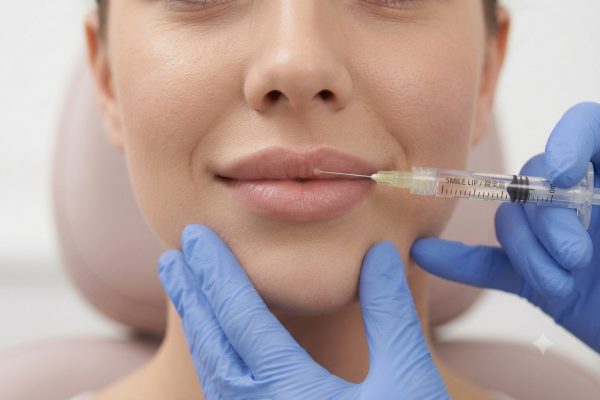
Why the Same Lip Filler Costs 3x More in Korea? From Doctor Technique to Material Choice
Material Difference — Lip-Specific vs. General-Purpose Fillers Are Not the Same
The lips are one of the most active facial areas — they move when you speak, eat, and smile. The filler used here must be soft, natural, and yet provide enough support to define the lip shape. This is a completely different requirement from fillers used on the nose bridge or chin.
Regular fillers (especially high-molecular or medium-density types) tend to be too firm — they often cause a granular or lumpy feel in the lips, and look unnatural when you smile. Lip-specific fillers (such as Restylane Kysse and Juvederm Volbella) use low-crosslinking technology, making them soft and elastic, moving naturally with the lips.
The price gap directly reflects material costs. General-purpose fillers cost approximately 180,000 to 350,000 KRW per 1cc in Korea. Lip-specific fillers like Restylane Kysse range from 660,000 to 1,320,000 KRW, and Juvederm Volbella is similarly priced. The difference is the premium for better material and better results.
Doctor Technique — Injection Depth & Dose Distribution Determine “Natural” vs. “Sausage Lips”
Material is the foundation, but technique makes the real difference. The same Restylane Kysse injected by different doctors can yield completely different results. Korean doctors pay meticulous attention to injection depth and dose distribution when performing lip procedures.
Injection depth: Lip tissue ranges from superficial mucosa to deep muscle layers. Superficial injections enhance redness and softness but don’t last as long; deep injections provide support and structure but require greater skill. Korean doctors typically use a layered approach — superficial for softness, deep for shaping.
Dose distribution: How 1cc of filler is allocated is where good aesthetics shine. Putting it all in the lower lip gives volume but no definition. Focusing on the lip tubercle, Cupid’s bow, philtrum columns, and corners creates a refined M-shaped lip. During consultation, a skilled doctor will use a mirror to show you exactly where and how much they plan to inject, rather than vaguely saying “1cc.”
Price Breakdown — Why 1cc Can Cost from 50,000 to 500,000 KRW
The wide price variation in Korean lip filler comes from four main factors:
Material brand. Korean-made fillers (e.g., Atiere) cost about 79,000–90,000 KRW/cc. Imported general-purpose fillers (e.g., standard Restylane, Juvederm) run 350,000–500,000 KRW/cc. Lip-specific options (Restylane Kysse, Juvederm Volbella) go for 660,000–1,320,000 KRW/cc. That’s a 10–15x range just in materials.
Doctor qualifications. A clinic director (lead doctor) charges 50–100% more than a junior practitioner. For example, Dr. Lee Hyun-joo at GoldJ charges 500,000–700,000 KRW/cc, while some Hongdae clinics offer the same filler for 200,000–300,000 KRW. The premium covers anatomical expertise and refined control over natural dynamics.
Treatment complexity. Simple lip augmentation is the base. Adding a corner lift (with Botox) adds 50,000–100,000 KRW. An M-shaped lip refinement (tubercle + Cupid’s bow + philtrum columns) requires more detail work and commands a higher price.
Location. Premium clinics in Gangnam (Cheongdam, Apgujeong) typically charge 400,000–800,000 KRW per session. Hongdae and Konkuk University areas, popular with younger crowds, can offer prices as low as 100,000–300,000 KRW. The difference covers rent and brand positioning.
| Filler Type | Price (KRW/1cc) | Approx. USD |
|---|---|---|
| Korean-made (Atiere, etc.) | 79,000 – 90,000 | ~$60–70 |
| Imported general-purpose (Restylane, Juvederm standard) | 350,000 – 500,000 | ~$260–380 |
| Lip-specific (Restylane Kysse / Juvederm Volbella) | 660,000 – 1,320,000 | ~$500–1,000 |
| Premium custom (lead doctor + lip-specific) | 500,000 – 700,000 | ~$380–530 |
Common Pitfalls — What Goes Wrong Most Often
“Sausage lips” — all filler in the middle. This is the most frequent fail. All 1cc goes into the lower lip or central area without being distributed to the tubercle, Cupid’s bow, or corners, resulting in a puffy, shapeless look.
Asymmetry — unbalanced injection points. Uneven volumes on left vs. right, or inconsistent distribution within one side, create visible imbalances.
Lumps & bumps — wrong material or too superficial. Using a high-molecular filler in the superficial lip layer often causes granules or firm spots. Lips need low-molecular or lip-specific products placed at the correct depth.
Short-lived results — insufficient dose or fast metabolism. Some patients see great results that fade within a week or two. This may be due to too low a dose, or the need for a higher-crosslinked lip-specific product.
Korean Aesthetic Trends — From “Big” to “Subtle but Better”
Lip aesthetics in Korea have shifted noticeably in recent years. The old ideal was “big and obvious”; today’s mainstream is “looks better but you can’t tell why.” This shows in several details:
Lip tubercle refinement matters more than overall thickness. A well-defined tubercle gives a natural pout, even without adding much volume to the rest of the lip.
Cupid’s bow and philtrum contrast are more important than volume. A crisp bow and full philtrum columns create natural three‑dimensionality. Many Korean doctors will ask during consultation, “Would you prefer a more defined or softer Cupid’s bow?”
Corners are lifted within a natural range. Overlifting looks forced and can distort speech and smiling expressions.
Korean doctors typically start with a facial proportion assessment, then tailor the plan to your face shape, nose-to-lip distance, and personal preference. What you want is not “bigger lips” but “better-shaped lips.”
- Pronounced tubercle: A subtle peak at the centre of the upper lip for natural pout
- Defined Cupid’s bow: A crisp M‑shape for refined lip architecture
- Slight upward corners: A gentle lift that creates a pleasant, natural smile expression