Ultherapy Side Effects: Risks and Recovery You Need to Know Before Going to Korea
Ultherapy has rapidly gained popularity in Korean dermatology. Many Gangnam clinics promote it as their flagship “no-downtime lifting” treatment, attracting clients who fly in from Southeast Asia specifically. But “no downtime” and “no risk” are two different things.
This article doesn’t discuss how great Ultherapy is — it focuses on the other side: 【Ultherapy side effects, risks, recovery, and potential adverse reactions】. If you’re considering Ultherapy in Korea, this is worth reading carefully.
What Ultherapy Actually Does
Ultherapy uses focused ultrasound technology to precisely heat three subcutaneous layers — 2.0mm, 3.0mm, and 4.5mm — to 55-60°C, stimulating collagen contraction and regeneration. It differs from Ulthera (HIFU) in having more uniform energy distribution and less pain, but 【it’s not non-invasive — it’s controlled “thermal injury.”】
Understanding this is crucial. All aesthetic treatments essentially work by “first destroying, then rebuilding.” Ultherapy’s “destruction” is controlled, but that doesn’t mean there’s no cost.
Ultherapy Side Effects: Normal vs. Warning Signs
Most Common Post-Treatment Reactions — These Are “Normal”:
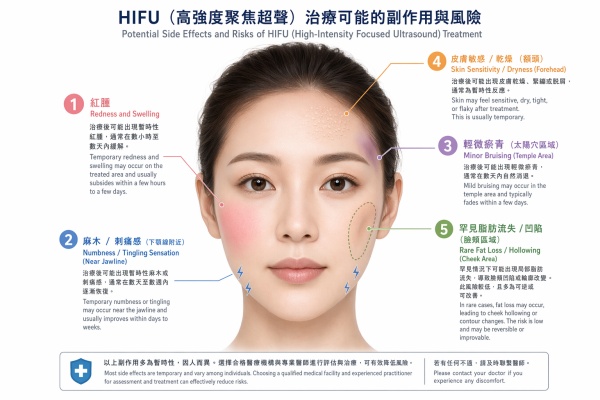
【Redness and swelling】
Mild redness and swelling appear after treatment — the most common reaction. For most, redness subsides within 【hours】; sensitive skin may last 【1-3 days】. This is a normal inflammatory response, not a concerning side effect.
【Aching or tenderness】
Post-treatment soreness or pain typically resolves within 【3-7 days】. One user described it as “being snapped by a rubber band,” most noticeable at the jawbone and cheekbone. This is a normal response to energy acting on deep tissue — temporary and expected.
【Temporary bruising】
Mild bruising may appear in treated areas, usually fading within 【days】. More common in those with abundant facial blood vessels.
【Skin dryness and roughness】
About 1 week post-treatment, skin may become dry, rough, and dull. A few experience localized dryness, itching, or rash. This indicates temporary barrier disruption — resolves within 【5-7 days】 with enhanced hydration.
- Serious Ultherapy Side Effects Requiring Attention:
The following are 【not】 normal reactions but genuine serious side effects. If they occur, contact your doctor immediately.
【Cord-like elevations】
Localized cord-like ridges may form after treatment. If this occurs, immediate ice application for about 20 minutes usually resolves it. If ice doesn’t help, doctor evaluation is needed.
【Skin burns and blisters】
Incorrect parameter settings or prolonged probe dwell time can cause burns, epidermal blisters, or even ulceration. May leave scars or pigmentation after healing. Legitimate clinics with experienced doctors can essentially prevent this. When choosing a Korean clinic, 【verifying doctor qualifications is more important than verifying device brand】.
【Facial depression】
This is Ultherapy’s most underestimated risk and the hardest to repair. Uneven energy distribution — excessive collagen proliferation in some areas, insufficient in others — can cause facial irregularities. Severe depression is extremely difficult to correct. Additionally, post-treatment cells that “fail to grow” due to insufficient energy can cause facial collapse or atrophy. 【This problem typically doesn’t appear immediately — it may emerge 1-3 months post-treatment during the collagen remodeling phase.】
【Nerve damage】
The face has dense nerve distribution, and Ultherapy reaches the fascia and dermis layers. Imprecise operation can affect facial nerves, causing 【temporary numbness, unnatural expressions, or even facial paralysis】. Experienced doctors can avoid this, but 【not all doctors can achieve this】.
【No visible effect】
Some may see no lifting effect at all. Causes include: insufficient energy, inadequate technique, or your skin laxity exceeding Ultherapy’s treatment scope. A single session has limited effect on severe laxity. While not a physical “side effect,” it’s a treatment risk worth understanding beforehand.
How Long Is Recovery?
【General recovery: 1-2 weeks.】
- 【Good constitution, fast metabolism:】 About 1 week for basic recovery
- 【Weaker constitution or improper aftercare:】 May need 2 weeks or longer
- 【Excessive energy or improper technique:】 Recovery significantly extended, with increased side effect risk
【First week post-treatment】 is the critical recovery window:
- Avoid saunas, steam rooms, hot springs, and strenuous exercise
- No smoking or alcohol
- Use lukewarm water for cleansing, avoid friction and exfoliation
- Strict physical sun protection, use repair products
【3-6 months post-treatment】, final results fully emerge. This is also the window when problems surface — if depressions, asymmetry, or other side effects occur, they typically become apparent during this phase.
Going to Korea for Ultherapy: What to Watch For
【Clinic “assembly line” model】
Some Korean clinics are known for “efficiency” — consultations may last only minutes, feeling more like “notification” than “assessment.” Doctors may not have time to carefully evaluate whether your skin truly suits Ultherapy. 【For a treatment requiring precise energy and depth judgment, this “fast-food” approach carries higher risk.】
【Package bundling】
Korean clinics often offer multi-treatment “packages.” Ultherapy is already a comprehensive lifting treatment — bundling other items may be unnecessary. Don’t be pushed by “great value” package pricing.
【Pain management】
Feedback indicates Korean clinics may not provide sufficient pain management. While Ultherapy is less painful than Ulthera, the jawbone and cheekbone areas still cause noticeable discomfort. Ensure the clinic provides adequate anesthesia and cooling measures.
【Aftercare “hidden pitfalls”】
Ultherapy’s final results take 【2-3 months】 to fully appear. If you fly back to Southeast Asia immediately after treatment, you can’t return for follow-up if side effects occur. Post-treatment depressions or asymmetry make cross-border recourse virtually impossible. 【Recommend staying in Korea long enough to complete the first follow-up visit.】
Summary: Ultherapy side effect severity depends on three variables:
- 【Doctor’s experience】 — energy settings, probe dwell time, depth judgment directly determine safety boundaries
- 【Device authenticity】 — genuine devices have certification; counterfeit devices have unstable energy output, doubling risk
- 【Your own care】 — post-treatment sun protection, hydration, avoiding heat determine recovery quality
Ultherapy is an effective anti-aging tool, but it’s not a “done and go” treatment. Understanding risks beforehand, choosing the right practitioner, and allowing sufficient recovery time matters far more than regretting afterward.
Disclaimer: This information is compiled from public sources for reference only. Specific risks and recovery should be determined by a professional doctor through in-person consultation.