Korean Rhinoplasty Materials Guide: From Silicone to Rib Cartilage, What Justifies the Price Gap
Rhinoplasty may be the most “competitive” procedure in Korean plastic surgery. On the streets of Apgujeong in Gangnam, any clinic can present dozens of options — silicone, ePTFE, ear cartilage, septal cartilage, rib cartilage, 3D-printed custom implants. An ordinary person walks in and gets dizzy within ten minutes from all the material names.
But the logic behind materials is not that complicated. 【Prices ranging from 20,000 to 150,000 RMB do not differ based on “expensive” vs “cheap” — they differ based on “what kind of nose you want to achieve.”】
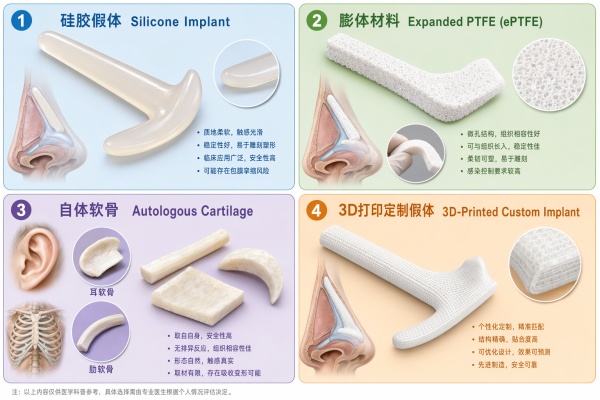
Silicone Implant: The Entry-Level Choice, Best Value
Silicone is one of the most widely used materials in Korean rhinoplasty. It typically comes in a slender “L” shape and is primarily used to increase nasal bridge height and definition.
【Advantages:】 Easy to carve, stable shaping, relatively low price. Silicone implants have no porous structure, so human tissue does not grow into them. If removal or adjustment is needed, the procedure is relatively simple.
【Disadvantages:】 People with thin skin may experience translucency, and long-term use carries a risk of capsular contracture. This is why Korean doctors now rarely use simple L-shaped silicone and instead wrap it with fascia.
【Price:】 Standard silicone starts at about 13,700-22,000 RMB. Imported products cost 20%-40% more due to manufacturing differences. Korean domestic brands like Hans Biotech and Sun offer good value and have KFDA certification. Simple silicone rhinoplasty in Korea costs about 8,000-15,000 RMB, while imported brands like Hans Biotech and Sun cost about 30,000-50,000 RMB.
【Suitable for:】 Those with good nasal bridge foundation and limited budget seeking their first rhinoplasty. One patient shared that her friend chose Hans Biotech silicone, and the shape remained stable 5 years post-surgery without feeling hard.
ePTFE (Expanded PTFE): Natural Feel, “Born-With-It” Nose
ePTFE holds a high position in Korean rhinoplasty, called by many doctors “the ideal biological tissue substitute.”
【Advantages:】 The surface has dense microporous structure that allows tissue ingrowth, resulting in a natural feel with virtually no foreign body sensation. Noses made with ePTFE by Korean doctors feel almost identical to real noses, and facial expressions look natural. Low inflammation rate, resistant to displacement.
【Disadvantages:】 Carving is more difficult than silicone, requires high surgical environment standards, and infection management is more complex than silicone. Also more expensive.
【Price:】 ePTFE rhinoplasty starts at about 22,000-30,000 RMB. American imported products cost about 40% more than Korean domestic ones. Wonjin Plastic Surgery’s ePTFE implants cost about 12,000-20,000 RMB.
【Suitable for:】 Those seeking natural feel, with thin skin, and demanding precise nasal contours.
Autologous Cartilage: The Gold Standard, Expensive for Good Reason
In Korea, autologous cartilage is considered the “gold material” for nasal surgery because it is harvested from your own body, with virtually no rejection, strong support, and lasting shaping results.
Ear Cartilage — The “Little Sprite” for Nasal Tip Shaping
Korean doctors love using ear cartilage for the nasal tip because its natural curve creates a tip with “fleshiness” that can be freely pressed and moved after surgery.
【Advantages:】 Hidden harvest site, inconspicuous post-ear scar, minimal trauma, fast recovery.
【Disadvantages:】 Limited support, not suitable for raising the nasal bridge alone.
【Price:】 About 25,000-40,000 RMB.
【Suitable for:】 Those with good nasal foundation who only need minor tip refinement.
Septal Cartilage — The “Dual-Player” for Bridge and Tip
Harvested from the septum inside the nasal cavity. Korean doctors consider it the ideal material for nasal tip shaping.
【Price:】 About 7 million KRW (about 35,000 RMB). Combined with silicone or ePTFE, about 20,000-50,000 RMB.
Rib Cartilage — The “Premium Option” for Nasal Reconstruction
Requires harvesting cartilage from the chest to build the nasal framework. Surgical difficulty and duration double.
【Advantages:】 Strongest support, suitable for short nose, flat nose, upturned nose, and other cases requiring significant nasal shape changes.
【Price:】 About 9 million KRW. Ear cartilage / septal cartilage rhinoplasty about 16,000-61,000 RMB; rib cartilage rhinoplasty about 17,000-62,000 RMB. Full rib cartilage comprehensive rhinoplasty 90,000-150,000 RMB.
【Suitable for:】 Those with poor nasal foundation who need significant nose shape changes. Multiple real patients chose semi-rib cartilage rhinoplasty.
3D-Printed Custom Implant: Latest Technology, Highest Barrier
Custom-made based on personal nasal CT data, with extremely high cost.
【Price:】 40,000 RMB and above. Currently only a few premium institutions offer this.
Why the Price Gap Is So Large — Treatment Combination Is Key
For the same rhinoplasty, the gap between 20,000 and 150,000 RMB comes down to treatment combination.
| Treatment Type | Reference Price |
|---|---|
| Simple rhinoplasty (bridge augmentation only) | About 13,700-55,000 RMB |
| Basic comprehensive (bridge + tip + alar) | About 27,500-70,000 RMB |
| Complex comprehensive (bridge + tip + alar + columella + nasal base) | About 38,000-120,000 RMB |
| Revision rhinoplasty | About 30,000-80,000+ RMB |
【General budget range for Korean rhinoplasty:】 First-time rhinoplasty about 18,000-50,000 RMB; rib cartilage comprehensive or revision about 50,000-80,000 RMB; complex revision may be higher. Note: Korea is canceling the medical tourism tax refund for foreign visitors starting 2026, which may increase actual rhinoplasty costs by about 10%.
How to Choose — Based on What Your Nose Needs
- 【Low bridge, decent tip】 -> Silicone or ePTFE simple rhinoplasty
- 【Rounded tip, wide alar】 -> Ear cartilage + alar adjustment basic comprehensive
- 【Short nose, flat nose, upturned nose】 -> Rib cartilage complex comprehensive
- 【Previous surgery, unsatisfied with results】 -> Revision rhinoplasty
A patient’s advice: “When I first went to Korea, I only thought about raising the bridge. After consultation, I realized alar and columella adjustments are priced separately. Combination packages can save 5%-15%.”
During consultation, the doctor will assess bridge height, tip support, alar width, septal condition, and surgical history, then calculate material fees, anesthesia, examination, and follow-up together. 【A more sensible approach: first understand what your nasal foundation requires, then check what is included in the quote.】
Disclaimer: Price information is compiled from public sources and industry reports for reference only. Please consult a qualified physician for specific costs and treatment plans.