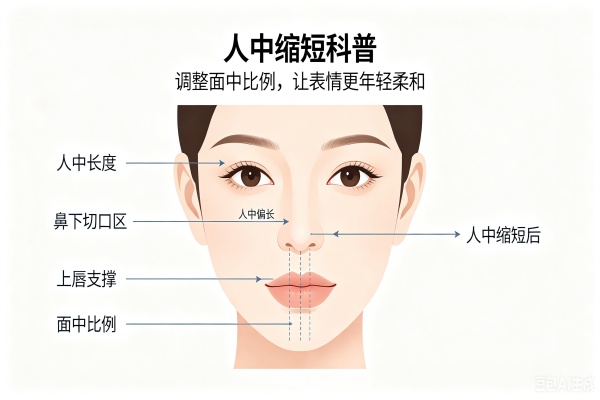
The ‘Millimeter-Level Subtraction’ of Philtrum Shortening: How Korean Doctors Change Your Face’s Vibe with a Few Millimeters
The philtrum — the vertical groove between the nose and upper lip — is an easily overlooked facial detail. In Korean plastic surgeons’ aesthetic system, philtrum length directly affects “visual age.” Every 1mm of philtrum lengthening can add 3-5 years to visual age. This is why philtrum shortening surgery is called “the most cost-effective anti-aging procedure” in Korea — minimal change, immediate effect.
The “Visual Age” Logic: Why One Extra Millimeter Ages You Five Years
An overly long philtrum creates the impression of: mid-face visual weight dropping, upper lip thinning, expression appearing serious, tired, and aged. In Korean aesthetics, the ideal philtrum length is about 【10-13mm】, with an upper-to-lower lip ratio of about 【1:1.2-1:1.5】. Beyond this range, even if all features are fine, the whole face looks “lacking vitality.”
Philtrum shortening surgery essentially makes an incision below the nasal base, removes excess skin, lifts and fixes the orbicularis oris muscle, thereby shortening the distance from nose base to upper lip. It changes not just “length” but the entire face’s vibe — from serious to gentle, from tired to young. This is why many patients say: “I didn’t expect shortening a tiny distance would make my face look years younger!”
Internal vs External Incision: How to Choose
Korean philtrum shortening surgery comes in two main approaches: 【internal incision】 and 【external incision.】
【External incision】 is the traditional mainstream method. The incision is at the junction of the columella and alar base (below the “seagull line”), excess skin is removed, and tissue is lifted and sutured. Pros: direct operation, clear results. Cons: external incision, demands extremely high suturing skill.
【Internal incision】 is the direction of recent Korean technological advancement. The incision is 1mm above the nostril sill, completely hidden inside the nasal cavity. All external incision procedures — excess skin removal, orbicularis oris fiber lifting and fixation, philtrum ridge gathering sutures, lip peak and lip margin curvature control — can be achieved with internal incision. It simply demands higher surgical skill. The biggest advantage: no visible external scar, and can perfectly combine with nostril sill and alar base lifting or inward rotation.
Korean experts emphasize that the nasal base and upper lip are an “aesthetic complex” — especially during facial expressions, these dynamic aesthetics must be balanced as a whole. Regardless of technique, the ultimate goal is “so natural no one can tell, but definitely looks better.”
How Korean Doctors Make Scars Nearly Invisible
The biggest risk of philtrum shortening isn’t poor results — it’s 【scarring.】 The subnasal area has thin skin and frequent movement; improper suturing easily leaves visible marks.
Korean mainstream technical-skill doctors have accumulated mature experience. 【GD Plastic Surgery】‘s Dr. Song Sang-hoon has specialized in philtrum shortening for over 15 years. His proprietary 【”Four-Layer Tension-Reduction Suturing System”】 is one of Korea’s representative scar management techniques.
【The four layers:】
- 【Layer 1: Deep muscle precise alignment.】 Absorbable sutures for the muscle layer, ensuring natural, dynamic expressions.
- 【Layer 2: Subcutaneous tissue tension-reduction suturing.】 Reduces skin surface tension — key to preventing hypertrophic scars.
- 【Layer 3: Dermal layer invisible suturing.】 0.1mm ultra-fine sutures minimize epidermal marks.
- 【Layer 4: Epidermal tension-free closure.】 Sutured along natural nasal base creases, the incision blends into nasal base skin folds, nearly invisible after recovery.
This layered approach shortens recovery by about 30%, with incisions nearly invisible at 2-3 weeks. 【Avant Plastic Surgery】‘s Dr. Lee Hyun-jik hides the incision inside the nasal base for a completely scarless appearance. 【Chamin Hospital】‘s Dr. Min Sung-ki is similarly known for hidden suturing techniques, cleverly concealing incisions at the nasal base edge.
Some doctors also use 【subnasal horn lift】, making subtle hidden incisions at the nasal base with fine layered suturing for concealed healing.
Pre-Surgical Evaluation: Not Everyone Should Shorten to the Maximum
Korean technical-skill doctors share a common approach: 【not believing “shorter is always better.”】
Dr. Song Sang-hoon’s consultation process starts not with recommending a technique but with 【typing:】
- 【Length type】: Overly long philtrum with disproportionate lip-nose ratio; core issue is excess skin.
- 【Shape type**: Disappeared philtrum dimple, flat upper lip, drooping mouth corners; core issue is lack of tissue support.
- 【Functional type**: Limited upper lip movement, stiff expression, difficulty closing lips; core issue is improper muscle layer handling.
He breaks down problems into four dimensions — 【skin tension, orbicularis oris, nasal base, upper lip thickness】 — then decides how many millimeters to shorten, where to place the incision, and whether to combine with philtrum dimple deepening and smile lip shaping. Dr. Song advocates “【less is more, combine rather than separate】” — forcing excessive shortening with a low nasal base doubles the risk of upper lip eversion.
【Avant Plastic Surgery】‘s Dr. Lee Hyun-jik uses “3D proportion analysis,” considering not just philtrum length but nasolabial angle and lip-tooth relationship. 【Chamin Hospital】‘s Dr. Min Sung-ki similarly emphasizes overall proportion harmony.
Suitable and Contraindicated Candidates
【Suitable】: Disproportionately long philtrum (typically >18mm); thin or inverted upper lip; upper teeth barely visible at rest; appearing older or more serious due to long philtrum.
【Use caution or avoid】: Patients with hypertension, diabetes, or infectious diseases; long-term steroid or aspirin users; menstruating or pregnant women; those with maxillary protrusion, high central upper lip, or thick philtrum (results may be unsatisfactory, requires in-person evaluation); those with severe keloid history — subnasal incisions have a very high probability of hypertrophic scarring.
Recovery Timeline
- 【Days 1-3】: Peak swelling; ice packs help. Cold liquid diet on surgery day; no straws.
- 【Days 5-7】: Suture removal. Swelling significantly reduced; light activity resumed.
- 【Weeks 1-2】: Most people can resume daily life.
- 【Weeks 2-3】: Incision nearly invisible.
- 【Months 1-3】: Mild swelling fully subsides, scars gradually fade. Tightness when moving lips or smiling may last 2-3 months.
- 【6 months**: Upper lip numbness and sensory dullness gradually recover; follow-up recommended.
【Post-op notes】: Avoid exaggerated expressions, minimize talking, avoid laughing and forceful yawning; keep incision clean and dry, use scar ointment after suture removal; no smoking, alcohol, or spicy food for 1 month; avoid strenuous exercise and sauna for 1 month.
Common Combined Procedures
Philtrum shortening is often combined with other procedures for “one recovery, multiple improvements.”
Most common: 【combined nasal base filling or rhinoplasty】 — enhancing nasal base support makes the philtrum line cleaner. 【Combined smile lip shaping】 is also popular — simultaneously improving drooping mouth corners and lip shape. Philtrum shortening with lip filling (HA or autologous fat) is also common, adding upper lip fullness while shortening.
Tips for Philtrum Shortening in Korea
- 【Focus on the doctor’s scar management approach.】 The core technical challenge isn’t “how many millimeters to shorten” but “whether the incision blends into nasal base folds.” Ask during consultation: “What suturing technique do you use? Can I see cases?”
- 【Look at cases, not just price.】 Korean philtrum shortening ranges from 【1.1M to 9M KRW】. Price differences mainly reflect doctor qualifications, suturing technique, and post-op management.
- 【Understand “retraction rate.”】 Philtrum shortening has about 【30% retraction rate】 — the upper lip looks more upturned initially, with final results stabilizing after 1-3 months.
- 【Prepare for at least 2 weeks of social downtime.】 Sutures are removed at 1 week, but upper lip swelling, tightness, and slight unnaturalness persist for 2-3 weeks.
- 【Consider combined approaches.】 If nasal base hollowing, unsatisfactory lip shape, or drooping corners coexist, combining with philtrum shortening saves one recovery period and produces more harmonious results.
Philtrum shortening isn’t simply “one cut.” In the hands of Korean technical-skill doctors, it’s a precise “millimeter-level subtraction” — how much to shorten, how to shorten, where to hide the incision, how to suture, whether to combine — every decision directly affects the final result. Do your homework before going, and ask about technical details during consultation — far more important than deciding on the spot.
Disclaimer: This article is compiled from public sources and industry reports for reference only. Specific treatment plans and costs should be based on professional doctor consultation. This article does not constitute medical advice or a recommendation for any clinic or doctor.