Korean Paranasal Augmentation: What’s the Difference Between 29,000 KRW and 1.2 Million KRW? Injection vs. Surgery Explained
Material Differences — From Korean Basic Fillers to Premium Imports, Prices Can Vary 30‑Fold
The biggest cost driver in paranasal augmentation is the filler material itself. The Korean market broadly divides into three tiers:
Tier 1: Korean‑made basic hyaluronic acid fillers. Brands like Atiere cost about 29,000 to 90,000 KRW (approx. $22–$68 USD). They are affordable but offer weaker support and shorter duration (6–9 months). Suitable for first‑timers or those on a tight budget.
Tier 2: Imported general‑purpose fillers. Such as standard Restylane and Juvederm, priced around 350,000 to 600,000 KRW (approx. $265–$455 USD). They provide good support and last longer (12–18 months), making them the most popular choice in Korea.
Tier 3: Regenerative or premium custom fillers. Including Ellansé, Radiesse, and Juvederm Voluma, costing about 700,000 to 1.2 million KRW (approx. $530–$910 USD). Besides volumizing, they stimulate collagen production and last 18–24 months, ideal for those seeking long‑term results.
A 30‑fold price gap reflects differences in support, longevity, and safety. The paranasal area is highly dynamic — using a low‑support filler increases the risk of migration or uneven absorption.
Practitioner Technique — Periosteum vs. Subcutaneous Layer Determines Migration Risk
Even with the same filler, results and duration can vary dramatically depending on who injects it. Two key factors make the difference:
Injection depth: The filler should be placed at the periosteum (bone surface) for deep structural support, where it stays anchored and is less likely to shift with facial movements. Superficial subcutaneous injections lack fixation and are prone to migration or lumps. Korean doctors routinely use periosteal injection — a critical step in minimising migration.
Dose distribution: Paranasal depression isn’t a single “hole” but a three‑dimensional zone. Experienced practitioners inject in multiple points rather than filling one spot. For example, the alar base gets deep support, while the columellar base may receive subtle superficial touches. Korean doctors often adopt a “small‑dose, multiple‑session” strategy, preferring to split the treatment rather than overfill at once.
Clinics like TOXNFILL in Hongdae have accumulated extensive experience in paranasal filler, and their doctors are highly skilled in periosteal injection. This is why the same material often yields better, longer‑lasting, and safer outcomes in the hands of an experienced practitioner.
How Long Do Results Last? Injection vs. Surgery Are Worlds Apart
Duration is one of the most frequently asked questions, and the answer depends entirely on the chosen method:
- HA fillers: 6–18 months. Korean brands last 6–9 months; premium imported ones (like Juvederm) can reach 12–18 months. Top‑ups are needed.
- Regenerative fillers (Ellansé, Radiesse): 12–24 months. They stimulate collagen, extending the effect beyond standard fillers.
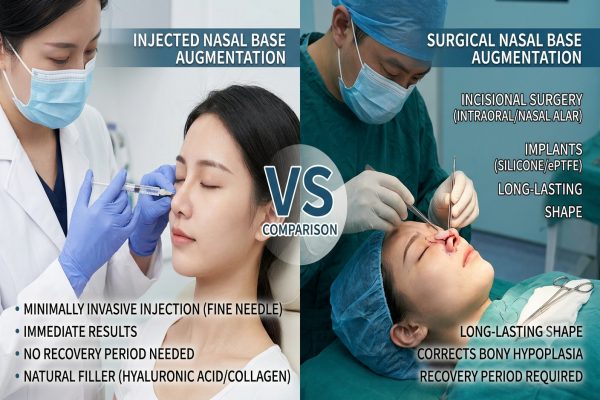
- Implants (silicone, Gore‑Tex): 5–10+ years. Permanent volume, but require surgery, longer recovery, and higher cost.
- Autologous cartilage grafts: Long‑term (permanent after survival). However, 10‑20% resorption is expected, and the procedure is more complex, requiring cartilage harvest.
Comparison: Injection vs. Surgery — Which One to Choose
| Comparison | Injection (HA/Regenerative) | Surgery (Implant/Cartilage) |
|---|---|---|
| Mechanism | Volumetric filling | Structural reconstruction |
| Best for | Mild to moderate depression | Moderate to severe depression |
| Invasiveness | Minimally invasive, needle only | Surgical incision (intraoral or intranasal) |
| Recovery time | 1–2 weeks | 1–3 months |
| Duration | 6–24 months | 5–10+ years |
| Migration risk | Highly technique‑dependent | Low, requires precise placement |
| Price (KRW) | 29,000 – 1,200,000 | from ~7,000,000 |
How Much Does Paranasal Augmentation Cost in Korea vs. Southeast Asia?
Injection‑based pricing in Korea is clearly tiered: basic from 29,000 KRW (~$22 USD), Korean‑made HA 1cc at 79,000–90,000 KRW (~$60–$68), imported HA 1cc at 350,000–600,000 KRW (~$265–$455), and regenerative fillers 1cc at 700,000–1,200,000 KRW (~$530–$910). Surgical implants start from about 7,000,000 KRW (~$5,300 USD).
For 1cc of imported HA filler, Singapore typically charges SGD 800–1,500 (approx. $600–$1,130 USD), while Korea costs roughly SGD 400–900 (approx. $300–$680 USD) — a 30‑40% saving. However, for injections alone, once you factor in flights and accommodation, the margin shrinks unless you’re already travelling to Korea. For surgery, the price difference is smaller, and cross‑border aftercare costs must also be considered.
Recommended Clinics for Paranasal Augmentation in Korea
Paranasal augmentation is one of their flagship procedures. During consultation, doctors analyse the cause of nasolabial folds and recommend a plan based on facial contour, with a focus on natural results and small‑dose, multi‑point injection.Price: on consultation
Known for transparent pricing and no mandatory packages. A good choice for those who prefer clear costs and no sales pressure.Price: from 29,000 KRW per area
Extensive experience in paranasal filler, especially with periosteal injection. Offers both injection and surgical implant options, tailored to the degree of depression.Price: injection from ~150,000 KRW