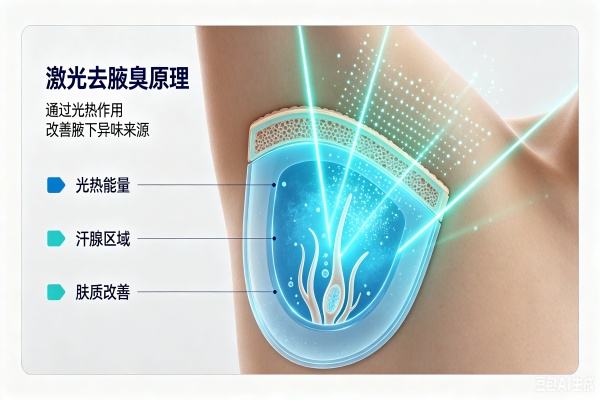
Laser Axillary Osmidrosis: No Incisions, No Stitches — How Precision Thermal Ablation Works
Although the recurrence rate for axillary osmidrosis surgery is low, many people are deterred by the mere mention of “surgery.” Traditional apocrine gland excision requires an incision in the axilla to remove tissue containing apocrine glands en bloc — the risks of postoperative hematoma, skin necrosis, and scar contracture are real. For teenage students and young office workers, the cost of taking leave and being unable to resume normal activities during recovery is simply too high.
Laser axillary osmidrosis treatment fills this gap perfectly — 【no incision, no stitches, normal activities on the same day after the procedure】, with efficacy comparable to surgery.
The Underlying Logic of Laser Axillary Osmidrosis Treatment: Not “Excision,” but “Thermal Coagulation”
The surgical logic for axillary osmidrosis is “excision” — removing the apocrine glands along with surrounding tissue. The laser logic is “thermal coagulation” — delivering laser energy through an optical fiber to a precise subdermal depth, using heat to destroy the secretory activity of apocrine glands while preserving the structural integrity of the epidermis and most of the dermis.
The most commonly used laser wavelength for axillary osmidrosis is 【1444nm Nd:YAG laser】, with the representative device being the AccuSculpt produced by Korea’s Lutronic Corporation. This wavelength features a high water absorption coefficient, concentrating energy primarily in the subcutaneous fat layer without damaging the epidermis. The physician inserts an ultra-fine optical fiber subdermally via puncture, and under local anesthesia, precisely delivers laser energy to the glandular distribution area — no scalpel, no sutures, no visible scarring throughout the entire process.
The whole procedure is akin to a “precision targeted elimination” beneath the skin — striking only the target, sparing the surroundings.
Clinical Data: Laser Efficacy Comparable to Surgery, with Significantly Faster Recovery
Multiple Korean university hospital studies provide relatively robust evidence for laser axillary osmidrosis treatment.
Korea University Ansan Hospital · 1444nm Nd:YAG Laser Long-Term Follow-Up
Follow-up of 18 axillary osmidrosis patients at 6 months post-treatment. Results showed: 【complete elimination of axillary odor in 20 sides, significant improvement in 12 sides, and unsatisfactory results in only 4 sides】. 14 patients fully satisfied, 3 partially satisfied, only 1 dissatisfied. Histopathological examination confirmed marked reduction in apocrine gland density and significant structural changes. Pain and activity limitation subsided 【significantly within 1 week and largely resolved within 4 weeks】.
Source: Korea University Ansan Hospital Clinical Study
Laser vs Surgery · Head-to-Head Comparison
45 patients enrolled (20 laser vs 25 surgery), with 【3-year follow-up】. There was 【no significant difference between the two groups in residual odor level and overall satisfaction】. However, the laser group reported 【significantly better pain scores, activity limitation, and quality of life scores compared to the surgery group】. No significant differences in side effects between groups.
Source: Korean Plastic Surgery Retrospective Study
Liposuction + Diode Laser Ablation · Combined Approach
18 patients underwent combined liposuction and diode laser ablation. Histopathological analysis showed 【no statistically significant difference】 in the proportion of glands removed compared to subcutaneous excision. However, the laser group experienced 【fewer perioperative complications and higher postoperative satisfaction】.
Source: Korean Academic Journal (2024)
Laser vs Surgery: A Table to Understand the Differences
| Comparison | Laser Axillary Osmidrosis | Surgical Axillary Osmidrosis |
|---|---|---|
| Procedure | Fiber optic puncture, no incision | 1-2cm incision |
| Anesthesia | Local anesthesia | Local or general anesthesia |
| Number of treatments | 2-3 sessions (4-6 week intervals) | 1 session |
| Recovery | 3-7 days | 1-2 weeks |
| Scar | No visible scar 1-2cm linear scar | |
| Pain score | Significantly lower than surgery Higher | |
| Efficacy | 85-90% (gradually cumulative) | 90-95% (one-time) |
| Suitable candidates | Young, fear surgery, moderate | Severe, seeking one-time resolution |
Recovery Experience: On a Completely Different Scale from Surgery
After surgical axillary osmidrosis treatment, the axilla requires compression bandaging, the arm cannot hang fully relaxed, and at least 1-2 weeks of rest is needed before resuming normal activity. The recovery process for laser axillary osmidrosis treatment is far lighter.
- 【Day of procedure:】 Mild burning sensation and swelling, no compression bandaging required, normal walking and light activity immediately post-procedure. Same-day discharge.
- 【Within 1 week post-procedure:】 Swelling and pain 【significantly reduced within 1 week】. Normal dressing, arm raising, and light housework possible. Does not interfere with school or work.
- 【Within 4 weeks post-procedure:】 Pain and activity limitation 【essentially fully resolved】. No noticeable discomfort in daily life.
- 【Side effects:】 Mild to moderate local swelling, 【most pronounced 2-3 days post-procedure, gradually subsiding within 5-7 days】. Common surgical complications such as scarring and hematoma are significantly less frequent in the laser group.
Who Is Suitable for Laser Axillary Osmidrosis Treatment
【Ideal candidates for laser axillary osmidrosis treatment:】
- 【Teenage students and young office workers:】 Korean studies explicitly identify laser combined with diode ablation as highly suitable for this demographic — rapid recovery with no impact on normal studies or work
- 【Individuals with moderate axillary osmidrosis who wish to avoid scarring】
- 【Individuals with surgical concerns who prefer less trauma】
- 【Those seeking “walk-in, walk-out” convenience】 — same-day discharge post-procedure
【Situations more suitable for surgery:】
- Severe axillary osmidrosis, seeking definitive one-time resolution
- No patience for the multiple treatments and gradual effect progression required by laser
- Willing to accept recovery period and scarring
Number of Treatments and Pricing
Laser axillary osmidrosis treatment typically requires 【multiple sessions】 to achieve optimal results. After a single laser treatment, apocrine glands are partially destroyed and odor is significantly reduced, but residual glands may still secrete small amounts. 【A full course typically requires 2-3 sessions】, with 4-6 week intervals. As treatment sessions accumulate, efficacy gradually compounds — from “significantly improved” to “nearly odor-free.”
Single laser treatment reference price is approximately 【5,000,000 KRW】. Total axillary osmidrosis treatment cost in Korea ranges from 【3,000,000 to 10,000,000 KRW】 (approx. 1,600-5,400 RMB), varying by number of sessions, hospital tier, and physician seniority.
Korean Laser Axillary Osmidrosis Clinic Reference
- 【Korea University Ansan Hospital Dermatology:】 One of the earliest institutions in Korea to conduct clinical research on 1444nm Nd:YAG laser for axillary osmidrosis, with relatively robust clinical data. University-affiliated hospital with a strong academic background.
- 【Kim Hun-gon Axillary Osmidrosis Clinic:】 Specializes in axillary osmidrosis and hyperhidrosis issues, offering laser treatment and other minimally invasive solutions.
- 【CHA&YOU Plastic Surgery & Dermatology:】 Equipped with over 50 high-end laser devices, axillary osmidrosis treatment is a signature service.
- 【Meiliteu Dermatology:】 Medical director is a board-certified dermatologist with over a decade of clinical experience, competitively priced.
Laser axillary osmidrosis treatment’s core advantage is not that “it works better than surgery” — efficacy is comparable. Its advantage lies in: 【no scalpel, no stitches, no scarring, fast recovery, no disruption to daily life】. Surgery achieves 90 points, but requires 1-2 weeks off; laser achieves 85-90 points, but you can be back at school or work the next day. For many, this trade-off is well worth it. If you can accept the rhythm of 2-3 treatments with gradually cumulative results, laser axillary osmidrosis treatment may be a better fit than surgery.
【Disclaimer:】
Information in this article is compiled from publicly available clinical studies and industry reports and is for reference only. Specific treatment plans and costs are subject to professional physician consultation and evaluation. This article does not constitute medical advice or endorsement of any device or brand.