Picosecond Laser for Skin Tone: How Photoacoustic Technology Outperforms Traditional Whitening
Online reviews of picosecond laser are just as polarized as other medical aesthetic treatments. Some say their skin became translucent and radiant, like a brand-new layer — totally worth it. Others say they spent a lot of money with hardly any change, and might as well have just used whitening serum. Same picosecond laser, why such drastically different experiences? The difference lies not in “whether picosecond works,” but in whether you understand “what picosecond can do” versus “how picosecond does it.”
The logic of picosecond laser for evening skin tone is fundamentally different from conventional whitening. Whitening serums work by “inhibiting melanin production”; picosecond laser works by “physically clearing already-existing melanin.” Understanding this distinction tells you why some find it worth it and others feel they wasted their money.
The “Pico” in Picosecond Is Not About Speed — It Is About Logic: Photoacoustic Effect vs Photothermal Effect
The “pico” in picosecond is a unit of time — 【1 picosecond = 10⁻¹² seconds】. Conventional Q-switched laser has a pulse width in nanoseconds (10⁻⁹ seconds); picosecond laser shortens this by 【a thousand times】.
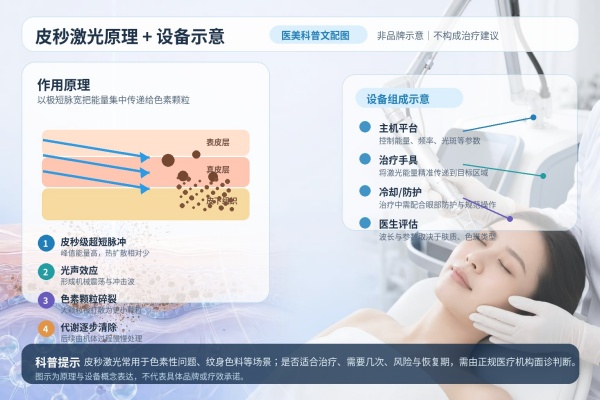
What does this gap mean? Conventional laser relies on “photothermal effect” — using heat to “burn” pigment away; the heat diffuses to surrounding tissue, hence the tendency for redness, rebound darkening, and longer recovery. Picosecond laser relies on the “【photoacoustic effect】” — using the ultra-short pulse width to generate high energy for instantaneous blasting, directly “shattering” pigment particles into micron-sized dust without relying on heat.
As an analogy: conventional laser breaks pigment chunks into 【gravel】; picosecond laser breaks them into 【fine sand】. Gravel requires the body to slowly process it; fine sand can be directly engulfed and metabolized by immune cells. Because it does not depend on heat, picosecond laser causes less damage to surrounding normal tissue, with 【lower risk of rebound darkening and shorter recovery】.
Uneven Skin Tone Is Not “One Disease” — Picosecond’s Multiple Wavelengths Address Multiple Issues
Uneven, dull skin tone may involve freckles, sun spots, melasma, post-inflammatory hyperpigmentation (acne marks), perioral darkening, or even multiple issues combined. 【Different depths and different types of pigment require different laser wavelengths to treat】.
One of the key advantages of picosecond laser is its 【multi-wavelength configuration】. Taking PicoWay as an example, it features 【532nm, 730nm, and 1064nm three wavelengths】. 532nm addresses 【superficial pigmentation】 (freckles, sun spots, age spots); 1064nm penetrates deeper, addressing 【deep pigmentation】 (melasma, nevus of Ota, acquired bilateral nevus of Ota-like macules); 730nm targets 【green and blue tattoos】 and other special pigments.
Different wavelengths correspond to different depths; the physician selects the appropriate wavelength based on your type of uneven skin tone — not “one machine to treat everything.” This is why the same “picosecond” produces good results for some and poor results for others — 【the right wavelength makes it effective; the wrong wavelength means a wasted session】.
Evening Skin Tone Is Only the First Step — Picosecond’s “Bonus Effect” Is What Many Truly Want
The “primary job” of picosecond laser for evening skin tone is clearing pigment. But many people find post-treatment that their skin 【not only got whiter, but also finer, firmer, with smaller pores】.
This is not an illusion. While clearing pigment, picosecond laser also generates microscopic damage in the dermis called “【Laser-Induced Optical Breakdown (LIOB)】.” These tiny vacuoles do not destroy the epidermis, but can 【activate the skin’s repair mechanism, stimulating the dermis to produce new collagen and elastic fibers】.
Thus, picosecond laser’s effect is 【dual-channel】: the photoacoustic effect handles 【clearing pigment】 (evening skin tone), while LIOB handles 【stimulating collagen】 (improving skin texture). The former makes you “whiter,” the latter makes you “more youthful.” This is also why picosecond is called the “all-in-one skin rejuvenation champion” — it simultaneously addresses pigmentation, dullness, pores, fine lines, acne scars, and more.
Picosecond Is Not “One Session and You’re Bright” — Number of Sessions, Intervals, and Post-Treatment Care Determine Final Results
Picosecond laser for improving uneven skin tone 【cannot be completed in a single session】.
- 【Superficial pigmentation】 (freckles, sun spots): generally requires 【1-3 sessions】, with 【4-6 week intervals】.
- 【Deep pigmentation】 (melasma, etc.): requires 【3-6 sessions】, with 【3-6 month intervals】.
- 【Dull skin tone, overall brightening】: typically recommended 【3-5 sessions as one course】.
【Post-treatment care is the other half that determines results】. Although picosecond causes minimal thermal damage, the skin barrier remains fragile post-treatment. 【Strict sun protection is the top priority】 — UV radiation is the pigment’s “archenemy”; skipping sun protection renders the treatment meaningless. At the same time, 【intensive moisturizing】 is needed, using fragrance-free, alcohol-free pure moisturizing products. If there are tiny crusts (approx. 3-5 days), 【let them fall off naturally; do not pick or peel them】.
Korean Picosecond Laser Price Reference — From a Few Thousand KRW to Hundreds of Thousands, What Accounts for the Difference
Korean picosecond laser prices vary widely, depending mainly on the device, institution, and whether add-on items are included.
| Treatment Type | Reference Price (KRW) | Approx. RMB |
|---|---|---|
| Maypure Pico Toning First Trial | 9,000 | approx. 48 |
| Beauty&Young Picosecond Single Session | 80,000 | approx. 430 |
| Maypure Picosecond Rejuvenation Single | 29,000 | approx. 155 |
| Picosecond Rejuvenation + Collagen Rejuvenation Combo | 160,000 | approx. 850 |
| Picosecond Rejuvenation 5 Sessions + Other Combo | 750,000 | approx. 4,000 |
【Korea vs Southeast Asia:】 Equivalent picosecond single session in Singapore typically SGD 200-500 (approx. 1,100-2,700 RMB); Korea’s entry price can be as low as just dozens of RMB, with routine single sessions around 150-800 RMB — 【50%-80% more affordable】. However, low prices are usually trial sessions or basic modes; deep pigmentation or melasma treatment requires higher-tier devices and more sessions, with prices rising accordingly.
Picosecond laser’s logic for evening skin tone is not “whitening” — it is “clearing.” It does not inhibit melanin production; it 【directly clears already-existing melanin】. So what it solves is “already-formed dullness and unevenness,” not “preventing future darkening.” If you can accept the rhythm of “multiple treatments, gradual improvement,” picosecond will most likely not disappoint. But if you seek “one session and you’re a shade whiter” and are unwilling to do post-treatment sun protection and moisturizing, it may not be for you. The logic of Korean dermatologists is: 【Picosecond gives you “clear what exists”; how to maintain it afterward depends on you.】
【Disclaimer:】
Information in this article is compiled from publicly available Korean sources, official brand releases, and industry reports, and is for reference only. Specific device selection, treatment plans, and costs are subject to professional physician consultation and evaluation. This article does not constitute medical advice or endorsement of any brand or device.