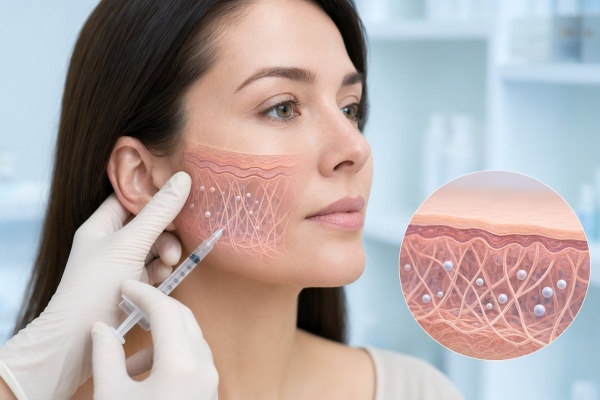
Sculptra Isn’t “Filling Pits” — Korean Doctors Explain How It Really Differs from Hyaluronic Acid Fillers
Online reviews of Sculptra are truly polarized. Some say their skin keeps getting tighter and their contours clearer months after treatment — totally worth it. Others say they spent big money and saw no change, and that hyaluronic acid fillers would have been faster. Same procedure, same goal — why such different experiences? The difference isn’t whether “Sculptra works” — it’s that you’ve been treating it like hyaluronic acid, expecting instant results the moment it’s injected. Sculptra’s underlying logic is completely different from hyaluronic acid fillers. This article skips the basic science and goes straight into the essential differences between Sculptra and fillers, how to choose among mainstream brands, the effect timeline, and where prices diverge, helping you decide whether it’s worth it.
The Essential Difference Between Sculptra and Fillers — “Filling Pits” vs “Growing Tissue” Are Not the Same Thing
Many people’s biggest confusion when first trying Sculptra is: “Why do I see no change after the injection?”
The root of this confusion is treating Sculptra like hyaluronic acid. Hyaluronic acid is physical filling — once injected, it creates volume, and results are immediate. Sculptra’s core ingredient is 【Poly-L-lactic acid (PLLA)】 or 【Poly-D,L-lactic acid (PDLLA)】, which does not provide volume on its own. Its function is to 【stimulate your own fibroblasts to generate new collagen】.
In other words, hyaluronic acid is “giving directly” — I put something in, and you see changes right away. Sculptra is “letting the skin grow on its own” — I give you seeds, and you wait for them to sprout, grow, and bloom.
This is also why Korean doctors call Sculptra “liquid Thermage” — its effect isn’t “filled in,” it’s “grown.” The results are not instant, but gradual.
Mainstream Sculptra Brands in Korea — PLLA vs PDLLA, One Letter Difference, Completely Different Effect Logic
Sculptra’s core ingredient falls into two categories: 【PLLA (Poly-L-lactic acid)】 and 【PDLLA (Poly-D,L-lactic acid)】. Mainstream brands on the market revolve around these two ingredient types.
Sculptra — PLLA Representative
The world’s original collagen stimulator, launched in Europe in 1999, FDA-approved in 2004. Flake-like microsphere structure, particle size approximately 50μm, stronger collagen-stimulating ability. The most extensive clinical data. Korea reference price: approximately 1,000,000 KRW/vial.
Aesthefill — PDLLA Representative
Developed by Korean REGEN Biotech, approved in Korea in 2014. Porous sponge-like microsphere technology, provides both immediate volumizing effect and continuous collagen stimulation. Requires high skill in reconstitution technique from the physician.
Juvelook — Hybrid Representative
85% PDLLA + 15% non-crosslinked hyaluronic acid. Hyaluronic acid provides “instant plumpness,” PDLLA provides “long-term regeneration.” Korea high-end dermatology clinics: approximately 4,800-5,800 CNY per vial.
GOURI — Liquid PCL Representative
Liquid PCL (polycaprolactone), no reconstitution needed, excellent diffusibility. Not designed for “filling” but for uniform distribution to induce autologous collagen generation. Maypure promotional price: approximately 590,000 KRW/5cc.
Sculptra’s Effect Timeline — It’s Not “Nothing,” It’s “Not Yet”
The most misunderstood aspect of Sculptra is how its results appear. It’s not a “instant transformation” treatment — it follows a 【slowly ascending curve】.
- 【1-2 weeks after injection:】 Basically no visible change. Some people feel their “face got bigger” due to slight swelling.
- 【1 month after injection:】 Approximately 68% of doctors observe improvement. Skin begins to show glow, contours have a slight tightening sensation.
- 【3 months after injection:】 Approximately 96% of doctors report improvement, Type I collagen increases by 66.5%. This is the “qualitative change period” — noticeable improvement in depressions, contour clarity increases.
- 【6-9 months after injection:】 Skin thickness increases by 26.1%, effects continue to accumulate.
- 【2 years (25 months) after injection:】 94% of doctors believe effects persist, 89% of patients report natural-looking results.
【Full course recommendation:】 Sculptra typically requires 【2 to 3】 injections (spaced 4-6 weeks apart) to achieve ideal results. A single injection has limited effect; only a complete course delivers a “qualitative leap.” Sculptra results can last 【2+ years】.
Common Side Effects of Sculptra — Nodules, Granulomas, and Over-Filling
Sculptra’s side effects are closely related to injection technique, individual differences, and post-treatment care.
【Nodules (most common):】 Excessive reconstitution concentration leads to severe subcutaneous inflammatory response, or too much injected at a single point, causing the immune system to recognize the material as a foreign body and encapsulate it into a hard lump. Incidence is extremely low under proper technique. Injecting too superficially, insufficient reconstitution, and excessive single-session dosage are the main causes.
【Granulomas:】 High concentration, incorrect dosage, or individuals prone to allergies or with low immunity are not suitable for Sculptra. The most common long-term complications are foreign-body granulomas and nodules.
【Over-filled face (puffy face):】 Excessive injection or lack of layered design leads to abnormal collagen proliferation, resulting in facial stiffness and tightness.
Korean doctors’ core principle is “【less is more】.” Choosing a legitimate medical institution and experienced physician can significantly reduce risks.
Korea Sculptra Price Reference — From 570,000 to 2,000,000 KRW, Where Does the Difference Lie
| Brand | Reference Price |
|---|---|
| Sculptra | 570,000-1,000,000 KRW/vial |
| Juvelook | Approximately 4,800-5,800 CNY/vial |
| GOURI | Approximately 590,000 KRW/5cc |
| Korea Sculptra overall range | 1,000,000-3,000,000 KRW |
| 【How much cheaper than Southeast Asia?】 Singapore Sculptra typically costs SGD 1,500-3,000 (approximately 8,000-16,000 CNY), while Korea costs approximately SGD 600-1,500 (approximately 3,200-8,000 CNY) — 40%-50% cheaper. However, Sculptra usually requires 2-3 injections for ideal results, so travel costs for a full course should be factored in together. |
Is Sculptra Worth It — It All Comes Down to Whether Your Expectations Are Right
Whether Sculptra is worth it ultimately doesn’t depend on the brand or the price — it depends on whether your understanding of “results” is correct.
- 【If you want “visible fullness the next day after injection” —】 Sculptra is not for you. Hyaluronic acid fillers are your option.
- 【If you can accept “no visible change for 1-2 months, gradual improvement starting at month 3, peak results at 6 months to 1 year” —】 Sculptra suits you well.
- 【If you think Sculptra means “one injection lasts forever” —】 Sculptra is not for you. The ideal approach is completing a 2-3 session foundational course, then touch-ups every 1-2 years as needed.
- 【If you view Sculptra as “investing time for 2 years of improved condition” —】 Sculptra suits you well.
【A frequently overlooked point:】 Sculptra’s effectiveness is directly related to your lifestyle. Late nights, sun exposure, and smoking all accelerate collagen breakdown. With the same product and the same injector, someone with a regular routine maintains results half a year longer than someone with an erratic schedule.
Korean dermatologists have a consensus on Sculptra: 【The quality of results depends 50% on the doctor’s technique, 30% on product selection, and 20% on you — your routine, sun protection, and post-treatment care all affect the final outcome.】 Sculptra isn’t “inject and forget” — it’s “the combined result of what’s injected and how you and your skin work together afterward.”
* Price information in this article is compiled from 2026 public quotes from mainstream Seoul dermatology clinics and is for reference only. Actual costs are subject to the hospital’s final consultation quote.