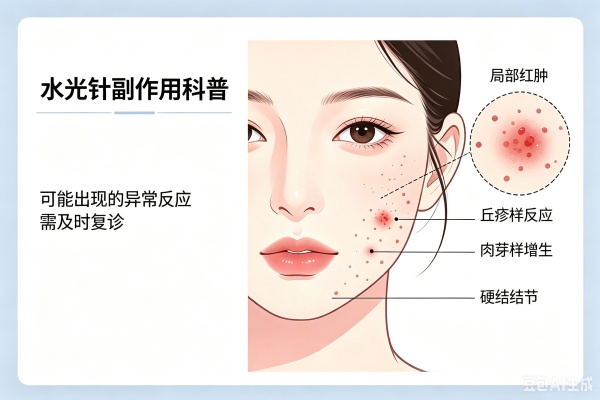
Skin Booster Side Effects: The Underestimated Risk of Granuloma After Treatment
Many get skin boosters expecting radiant skin, only to find hard little lumps appearing on their face instead of the glow they anticipated. Searching online, some say “it’ll go away in a few days,” others say “these are normal papules.” Who’s right?
The answer depends on one critical judgment: whether what appeared after your skin booster is 【normal “papules”】 or 【abnormal “granuloma”】. They look somewhat similar but are fundamentally different.
First Step: Is It Normal or Abnormal?
Right after skin boosters, rows of small bumps appear on the face — 【the vast majority are normal】. Skin boosters use needles to inject nutrients into the dermis, forming micro-reservoirs under the skin. These small bumps typically 【fade within 1-3 hours post-treatment】, with full recovery within about a week. If the bumps gradually disappear within 3-5 days to a week, it’s part of normal recovery.
- Warning: If the small papules 【haven’t subsided after 1 week】, or reappear after fading, or show 【redness, hardening, itching, or burning sensation】, this is likely not a normal post-treatment reaction but an 【early sign of foreign body granuloma.】
Among skin booster side effects, granuloma is the easily underestimated “hidden threat” because its incubation period can last weeks or even months. Many develop lumps a month after treatment and never connect it to the earlier skin booster.
What Is Granuloma — The Immune System’s “Overreaction” to Skin Boosters
Granuloma is essentially a chronic inflammatory proliferative reaction where the immune system responds to substances injected during skin boosters. Simply put, after treatment, your immune system identifies certain ingredients as “foreign invaders,” mobilizes immune cells to attack them, and over time, nodular granulomas form.
Foreign body granuloma after skin boosters is relatively rare clinically but 【difficult to treat】. It differs from ordinary post-treatment redness and swelling — it’s the skin immune system’s rejection and encapsulation of foreign material, directly affecting facial appearance and skin health.
Three Core Causes of Granuloma After Skin Boosters
- Product Factors: Unknown Ingredients, Hidden Risks
Using non-standard, unqualified skin booster products is a leading cause of side effects. These products may contain non-metabolizable ingredients, impurities, or excessive cross-linking agents that cannot be absorbed by the body, continuously stimulating tissue and triggering inflammation.
Proper skin boosters use 【human-compatible non-cross-linked hyaluronic acid】 — fast-metabolizing and highly compatible. But counterfeit or low-quality products may contain impurities, unrefined materials, or unknown additives. Some who opt for cheap options get 【cross-linked skin boosters】 — the large cross-linker molecules metabolize slowly, accumulate in the dermis, and easily trigger proliferative reactions.
- Technique Factors: Improper Injection, Local Accumulation
Injecting too superficially, excessive dosage per point, or uneven delivery can cause foreign material to accumulate locally, affecting normal metabolism and absorption. Non-standard injection depth — too deep or too shallow — can also affect absorption and cause abnormal tissue reactions. Inadequate sterilization or compromised skin barrier during injection increases granuloma risk.
- Individual and Care Factors: Sensitive Constitution, Post-Treatment Mishaps
Individual skin sensitivity and abnormal immune status can affect reactions. Those with allergic constitutions face higher risk — their immune systems react more strongly, and even legitimate skin booster materials may be targeted as “enemies.” Improper post-treatment care, such as premature makeup application, contaminated needle holes, or exposure to unclean water, can also trigger or worsen inflammation.
What to Do If Granuloma Appears
【The most important principle: seek medical attention early. Do not self-medicate, squeeze, or hope it resolves on its own.】
Granuloma in early stages mostly presents as inflammatory red nodules. With timely intervention through anti-inflammatory, metabolism-promoting, and barrier-repair treatments, the vast majority can fully resolve with natural skin restoration. But if delayed to the chronic granulomatous scarring stage, treatment becomes complex — medicine still aims for “improvement” rather than “zero-trace” repair for scars.
Common treatment methods:
- 【Medication:】 Oral anti-inflammatory or immunomodulatory drugs to control inflammation at the source
- 【Local injection:】 Intralesional corticosteroid injections to effectively suppress inflammation and promote absorption
- 【Hyaluronidase:】 If medication is ineffective, local injection of hyaluronidase can dissolve hyaluronic acid
- 【Light/laser therapy:】 Specific wavelength lasers or IPL targeted at the lesion area — earlier treatment means less collagen destruction and lighter atrophic scarring
Key Reminders
【Skin boosters are medical aesthetics, not ordinary beauty treatments.】 A skin booster typically involves over a hundred tiny needle punctures, with strict depth requirements. The practitioner needs extensive medical knowledge of skin structure, layers, and pathophysiology. Getting skin boosters at non-standard facilities carries far higher risks than at legitimate medical institutions.
Lumps after skin boosters don’t necessarily mean something went wrong — normally they fade within days. But 【redness, hardening, or papules lasting beyond 1-2 weeks】 should not be self-treated — see a doctor immediately. Choosing legitimate medical facilities, verifying product credentials, and following professional medical advice are the most effective ways to avoid skin booster side effects.
Disclaimer: This information is compiled from public sources for reference only. If experiencing discomfort, seek medical attention promptly. Specific diagnosis and treatment should be determined by a doctor through in-person consultation.