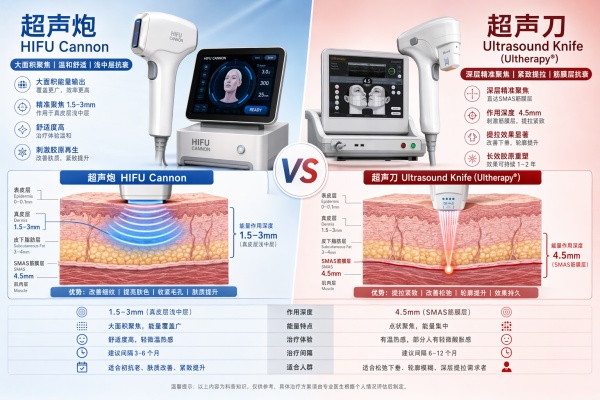
Ultherapy vs HIFU: What’s the Difference? Comfort Lifting vs Precision Targeting in Korea
In the world of anti-aging discussions, Ultherapy and HIFU (Ulthera) are unavoidable names. Some say their jawline became sharper after treatment; others praise the results without any downtime. Both are non-invasive anti-aging treatments, so why are their effects so different?
The core difference in one sentence: 【In the Korean market, Ultherapy is the comfortable, no-downtime lifting device, while HIFU is the high-intensity precision lifting classic instrument.】 One is for “comfortable maintenance,” the other for “powerful lifting.” This article breaks down the differences between Ultherapy and HIFU across four dimensions: principle, certification, price, and results.
The Korean market is undergoing a noticeable generational shift. Ultherapy, with its “walk in and walk out” convenience, is replacing HIFU as the top choice for younger clientele, while HIFU maintains its premium positioning for clients with moderate to severe sagging.
Ultherapy and HIFU: Same Origin, Different Paths
Both Ultherapy and HIFU belong to focused ultrasound technology. Their working principle is similar — both focus ultrasound energy at specific depths beneath the skin, generating thermal effects to stimulate collagen contraction and regeneration for tightening and lifting.
But their technical approaches are completely different.
【HIFU】 uses High-Intensity Focused Ultrasound technology. Like a “sniper rifle,” it precisely focuses ultrasound energy at specific subcutaneous depths (1.5mm, 3.0mm, 4.5mm), generating instantaneous temperatures of 60-70 degrees Celsius. It creates “micro-injuries” through thermal coagulation points to stimulate new collagen. The energy is concentrated on tiny points (about 0.7mm in diameter), with local temperatures reaching 70-80 degrees.
【Ultherapy】 uses “large-field focusing technology” and “super-pulse technology.” The large-field (2.5-3mm diameter) focusing technology effectively reduces energy density in the treatment area, making the thermal effect on tissue more uniform and gentle. The super-pulse technology delivers higher peak power with shorter action time, minimizing thermal damage to surrounding tissue. Think of it this way: HIFU is “point heating,” Ultherapy is “surface heating.”
Certification and Compliance: Ultherapy Has a Smoother Path in Korea
Currently, Ultherapy devices have passed relevant Korean certifications and are gradually expanding in the Korean market. Premium dermatology clinics in areas like Gangnam have begun introducing the device for clients seeking “no-downtime lifting.” Traditional HIFU has been used in the Korean market for over a decade, but as regulations tighten and consumers demand more comfort, Ultherapy is becoming the preferred alternative for younger clientele.
Pain and Experience: Ultherapy Is Comfortable, HIFU Hurts
HIFU concentrates energy at high temperatures, causing noticeable pain during treatment. Topical anesthesia is usually needed. Some describe it as “a rubber band snapping against the face,” especially around bony areas like the jawline and eye region. Post-treatment may involve brief redness, slight bruising, and a recovery period of 3-7 days.
Ultherapy uses large-field and super-pulse technology, with temperature controlled at 55-60 degrees Celsius. It does not create coagulation denaturation points or scar adhesions. Pain is minimal, and most people need no anesthesia. 【There is no downtime — you can return to normal life immediately after treatment, with occasional mild redness that fades quickly.】
In short: 【if you are pain-sensitive, choose Ultherapy; if you can tolerate pain, HIFU delivers stronger results.】
Price: Ultherapy Is Affordable, HIFU Is Expensive
【Ultherapy】 in the Korean market costs approximately 800,000-2,000,000 KRW (about 4,200-10,600 RMB) per session, with some areas offering promotional rates as low as 500,000 KRW. A full course (typically 2-3 sessions) costs about the same as a single HIFU session, but the payment is spread out, reducing financial pressure.
【HIFU】 typically costs 1,500,000-3,500,000 KRW (about 8,000-18,500 RMB) per session. Due to high equipment costs and strict consumable management, it is more suitable for clients with ample budgets seeking “one-and-done” results.
Results and Duration: HIFU Is Powerful, Ultherapy Is Gradual
HIFU creates “immediately visible” lifting effects, especially for moderate to severe sagging issues like blurred jawlines and descending apple cheeks. A single session can achieve noticeable improvement. Results last approximately 【1-1.5 years】.
Ultherapy delivers milder results per session, but through 2-3 cumulative treatments (1 month apart), the combined effect can exceed 30% improvement. There is no downtime — you can wear makeup and socialize the next day. Results last approximately 【8-12 months】.
Treatment Range: HIFU Is Limited, Ultherapy Is Precise
HIFU’s treatment area is relatively restricted. Fine areas like the periorbital and perioral regions are difficult to treat. People with very little facial fat or severe skin laxity may see limited results.
Ultherapy is equipped with 2.0mm, 3.0mm, and 4.5mm depth treatment heads, enabling layered treatment of the dermis, fat layer, and SMAS fascia. It also features a sliding handpiece that easily treats fine areas around the eyes, mouth, nasolabial folds, and neck. It is more friendly for sensitive skin and thin skin.
Summary: A Table to Help You Choose
| Comparison | Ultherapy | HIFU |
|---|---|---|
| Technology | Large-field focus + super pulse (surface heating) | High-intensity focused ultrasound (point heating) |
| Temperature | 55-60 degrees C | 60-70 degrees C |
| Certification | Certified in Korea, expanding | Used in Korea for years, classic |
| Pain | Mild, no anesthesia needed | Noticeable, requires topical anesthesia |
| Downtime | None, walk in and out | 3-7 days |
| Price per session (KRW) | 800K-2M | 1.5M-3.5M |
| Result characteristics | Gradual, requires multiple | Immediate, single session effective |
| Duration | 8-12 months | 1-1.5 years |
| Treatment range | Fine areas like eyes and mouth | Fine areas restricted |
- Choose Ultherapy if you: are pain-sensitive and want comfort; are 25-45 with early signs of aging; want to treat fine areas like periorbital and perioral regions; have a limited budget but can invest in stages.
- Choose HIFU if you: can tolerate some pain; want noticeable lifting in a single session; have moderate to severe facial sagging; have an ample budget.
The difference between Ultherapy and HIFU comes down to two words: “comfort” and “power.” Understanding your own needs and tolerance matters more than reading a hundred online guides. Be realistic about results, and choose a legitimate clinic — that is more important than following trends.
Disclaimer: This information is compiled from public sources for reference only. Please consult a qualified physician for personalized treatment plans.