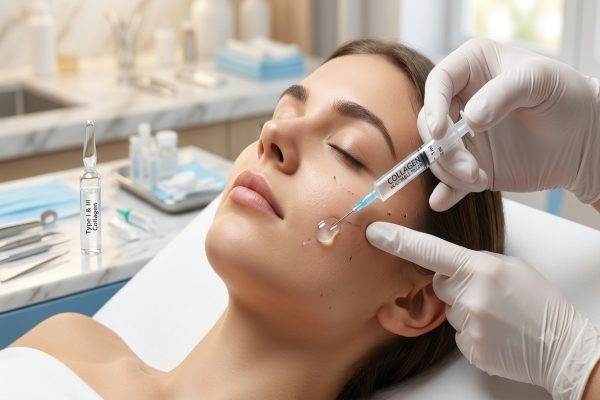
Collagen Injections: How Korean Dermatology Is Redefining Anti-Aging
From Filling to Regeneration: A Fundamental Shift
Collagen injections in Korea are classified as “basic skin maintenance” — a category that signals they are no longer a one-off fix for damage, but a routine part of long-term skincare. Traditional collagen injections “directly supplement” the skin with animal-derived collagen. But this approach has clear limitations: allergic reactions to xenogeneic collagen are a real concern, and the effects are short-lived because exogenous collagen is eventually metabolized by the body.
The new generation of collagen injections works on an entirely different principle. Take Juvelook, currently one of the most discussed products in Korea. Its core ingredients are PDLLA (Poly-D,L-Lactic Acid) and non-crosslinked hyaluronic acid. The HA provides immediate fullness after injection, while the PDLLA microspheres continuously activate fibroblasts over the following 2 to 4 weeks, stimulating the skin to produce its own collagen. This “immediate effect + long-term regeneration” dual-phase design is fundamentally different from simple HA fillers.
Juvelook holds certifications from the US FDA, Korean KFDA, and European CE, and has won the Korean Consumer Award “Skin Booster of the Year” for two consecutive years. But it’s far from the only player — the Korean market is rapidly diversifying, with human-derived collagen, porcine collagen, recombinant collagen, and various “collagen stimulators” all competing for the same space.
The Three Layers of Collagen Injection: Supplement, Stimulate, Regenerate
Understanding the Korean collagen injection market requires distinguishing between three distinct levels of action.
Level 1: Direct Supplementation. Products like TheraFill, derived from porcine atelocollagen, are injected directly into the dermis to fill wrinkles and soft tissue defects. Results are immediate but short-lived, and allergic risks remain. In Korea, these are mostly used for fine-line corrections such as neck wrinkles.
Level 2: Stimulation. Products like Sculptra (PLLA) and Juvelook (PDLLA) are not collagen themselves, but use microparticles to stimulate fibroblasts to produce collagen. Results are gradual — visible 2 to 4 weeks post-injection, peaking at 3 to 6 months — and last 12 to 24 months after a full course. Sculptra in Korea costs about 300,000 to 700,000 KRW per session, typically requiring 2 to 3 sessions.
Level 3: Regeneration. This is the newest and most advanced direction in Korea. Liquid PCL injections like GOURI go beyond “stimulating” collagen — they reconstruct the extracellular matrix (ECM) for structural skin regeneration. In 2026, GCELLE is entering the Korean market with human-derived collagen enhancers. Products like LITWO, which inject human-derived ECM directly, represent a complete departure from the “single-ingredient supplementation” model.
These three levels aren’t about “which is better” — they’re about “which is more appropriate.” Direct supplementation is for immediate correction of specific depressions. Stimulation is for long-term skin improvement. Regeneration is for those pursuing structural rejuvenation.
Real Pricing in Korea: From 200,000 to 800,000 KRW — Where Does the Gap Come From?
Collagen injection prices in Korea vary significantly by brand, dosage, and clinic.
| Product | Volume | Reference Price (KRW) |
|---|---|---|
| Juvelook Black | 2cc | ~200,000 |
| Juvelook Black | 3cc | ~330,000 |
| Juvelook Black | 4cc | ~400,000 |
| Juvelook Blue | 1 vial | ~350,000 |
| Rejuran Black | 2cc | ~330,000–380,000 |
| Sculptra | per session | ~300,000–700,000 |
Three core variables drive price differences: brand and ingredients (PDLLA vs. PN have different pricing), dosage and area (2cc for eyes vs. 4cc for full face), and clinic location (Gangnam premium clinics can be 2–3 times more expensive than Hongdae).
One easily overlooked fact: the “per-session price” doesn’t represent the “full course price.” For Juvelook, the complete effect requires 3 sessions (one month apart), followed by top-ups every 6 to 12 months. Multiply the per-session price by 3, plus maintenance, to get the real annual investment.
The Truth About Results: Not a “Face Change,” but a “Skin Transformation”
The most common misunderstanding about collagen injections lies in how the results appear. HA fillers deliver “instant gratification” — volume appears immediately. Collagen stimulators deliver “delayed feedback” — almost no visible change in the first 3 days, skin brightening and pore refinement around day 5, with the peak effect at 2 to 4 weeks.
One patient described it: “For the first time, I felt that sense of ‘my collagen is back.’ It’s not the fake plumpness of fillers — it’s a healthy glow radiating from within the skin.”
This “delayed feedback” is a double-edged sword. For those seeking instant results, it may feel “too slow.” For those seeking natural improvement, it perfectly avoids the “I can tell you had work done” look. In Korea, collagen injections are often called “the bare-face injection” — because the goal is skin so good it needs no makeup.
Another common misconception is about “duration.” Many assume “lasting 12 to 24 months” means “one session covers two years.” In reality, the full effect requires 3 sessions — and the duration refers to how long the effect lasts after the final session, not after a single injection. Planning 3 sessions as a complete course is the only way to achieve the claimed duration.
Collagen Injections in Korea: Not a Single Product, but a “Combinatorial Logic”
In Korean dermatology, collagen injections are rarely used alone. They’re typically part of a larger protocol.
Juvelook + Rejuran is one of the most classic Korean combinations. Rejuran repairs the skin barrier and calms inflammation; Juvelook stimulates collagen and refines contours. Together, they address both “skin quality” and “structural definition.”
Collagen injections + energy-based devices are also common. Thermal devices like Thermage and Ulthera stimulate immediate collagen contraction and neogenesis, while collagen injections provide sustained fibroblast activation — one delivers “instant tightening,” the other “long-term regeneration.”
Collagen injections + botulinum toxin complement each other across dynamic and static wrinkles — toxin addresses expression lines, collagen injections address static wrinkles and skin laxity.
This “combination logic” reflects a core principle in Korean dermatology: no single product can solve everything, but layering different products can cover every skin layer — from epidermis to SMAS fascia.
The Boundaries of Collagen Injections: What They Can’t Do
- They can’t replace HA fillers for severe volume loss. For structural support in the nasolabial fold or temple, HA fillers remain the most direct solution.
- They can’t fix severe skin laxity. For SMAS-level sagging, collagen injections are insufficient — facelift surgery or threads are the appropriate approach.
- They don’t replace daily sun protection. Injection cannot offset UV-induced collagen breakdown from poor skincare habits.
- They’re not for everyone. Those with allergies to collagen or injection components, pregnant or nursing women, and those with autoimmune conditions require professional evaluation before proceeding.
The popularity of collagen injections in Korea reflects a deeper transformation: dermatology is moving from “repair” to “regeneration.” It’s no longer just about “filling holes” — it’s about “empowering the skin to fill its own holes.”
In the logic of Korean dermatologists, collagen injections aren’t about buying a “service” — they’re about investing in a “long-term stable skin condition.” Those who understand this rhythm don’t find it “not worth it.”