Thread Lift Barb Logic: Slimmer Face vs Hollowing | Korea Guide
Online reviews about thread lifts are truly polarized. Some say their jawline became defined and apple cheeks were lifted; others say they spent a fortune and not only saw no lifting but ended up with facial hollowing and unnatural expressions. The difference isn’t in “whether to get a thread lift,” but in which type of thread is used, what tissue layer the threads are placed in, and how precisely the doctor controls the tension. This article skips the basic theory and goes straight into the barb physics of thread lifts, how to choose between different thread types, the effect timeline, and what drives the price differences.
The Physics of Thread Lifts — Barb Direction Determines Lifting Direction
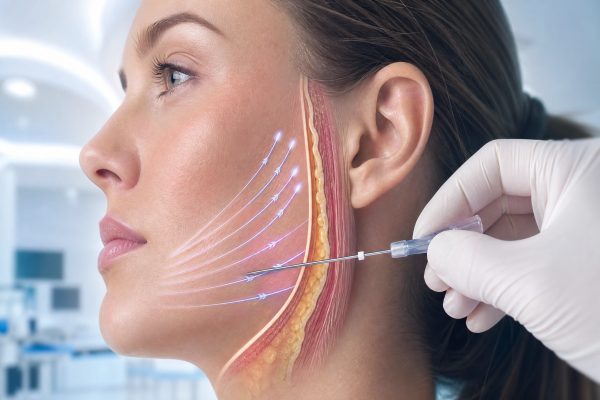
Many people think a thread lift simply means “inserting a thread into the skin to pull the face up.” The core technology lies in the【barb (cog) design on the threads】. These barbs are directional — facing the opposite direction of the lift. The doctor inserts the thread into the subcutaneous tissue, then pulls in reverse so the barbs “grip” the tissue, repositioning sagging soft tissue upward and anchoring it in a new position. At the same time, the thread, as a foreign body, stimulates a mild inflammatory response, triggering collagen and elastin regeneration.
In other words, a thread lift works on two levels: the physical level — barbs pull sagging tissue upward for immediate results; the biological level — the thread stimulates collagen regeneration for gradual, delayed results.
PDO, PLLA, PCL — Thread Type Determines Longevity and Lifting Power
Thread Type Longevity Characteristics Reference Price (per thread)
PDO 1-1.5 years High safety, low allergy rate, limited lifting power 99,000-150,000 KRW
PLLA 5-7 years Tensile strength 2-4× that of PDO, higher price 200,000-300,000 KRW
| PCL | 9 months-1 year | Balanced safety and durability, slightly higher bruising rate | 200,000-300,000 KRW |
|---|---|---|---|
| 【How to choose?】Mild sagging, limited budget → PDO thread (e.g., MINT thread); Moderate sagging, need stronger lift → PLLA thread; Balanced effect and safety → PCL thread. Korean doctors typically recommend combining types — PLLA or PCL for deep structural support, PDO for superficial fine lines. |
Why Some People Get Facial Hollowing — Tension Control and Placement Depth Are Key
【Excessive tension:】If the doctor pulls threads too tight chasing “dramatic lifting,” the barbs create excessive traction, causing surface depressions or “grooves.” Korean doctors use progressive lifting — adjusting tension by zone and layer, erring on the side of “conservative” results.
【Incorrect placement depth:】Threads should be placed between the subcutaneous fat layer and the SMAS fascia layer. Too shallow and threads may show through the skin or cause depressions; too deep and they may damage facial nerves or blood vessels.
【Wrong thread choice:】Using overly thick or densely-barbed threads on thin skin areas (around the eyes, around the mouth) easily causes localized hollowing. Korean doctors select different thread specs based on skin thickness per zone.
Thread Lift Effect Timeline — From “Instant Lift” to “Collagen Regeneration”
- 【Immediately post-procedure:】Barbs instantly reposition sagging tissue upward. Lifting is visible, but swelling means the result is “discounted.”
- 【1-2 weeks post-procedure (swelling subsides):】Swelling resolves, lifting stabilizes. This is when most people are happiest.
- 【1-3 months post-procedure (collagen regeneration):】Threads stimulate collagen and elastin production, further tightening the face.
- 【3-6 months post-procedure (stabilization):】Threads begin absorbing, but newly formed collagen has “taken over” support duty. Results look most natural and stable.
- 【Longevity:】PDO threads approximately 1-1.5 years, PLLA threads approximately 5-7 years.
Korean Thread Lift Costs — Why Prices Range from Hundreds of Thousands to Millions of KRW
【Thread type:】Basic PDO approximately 99,000-150,000 KRW per thread; MINT thread 8-pack approximately 580,000 KRW; PLLA/PCL approximately 200,000-300,000 KRW per thread.
【Thread quantity:】Localized lifting (jawline, brow tail) typically needs 4-8 threads; full-face lifting needs 15-30 threads.
【Treatment area:】Localized thread lift from approximately ¥8,000 RMB; basic full-face from approximately ¥12,000 RMB; deep SMAS layer from approximately ¥15,000 RMB.
【Doctor level:】Chief doctor vs. general practitioner: 30%-50% price difference. Chief doctors offer more precise tension control and placement.
【Korea vs. Southeast Asia:】Full-face thread lift in Korea approximately $1,500-$3,500 USD; Thailand approximately $1,200-$2,500 USD; Singapore typically more expensive.
Common Thread Lift Pitfalls — What to Avoid
- 【Comparing price only, ignoring thread material:】PDO and PLLA are in completely different leagues for both price and results.
- 【Pursuing “more is better”:】More threads don’t equal better results — excessive threads may cause facial stiffness.
- 【Neglecting aftercare:】Avoid exaggerated expressions, vigorous chewing, massage, strenuous exercise, and high-temperature settings for 1-2 weeks post-procedure.
- 【Expecting permanent results:】Threads are absorbable; results have a defined duration.
【Must-ask questions during consultation:】What brand of threads is used? How many threads total? Which areas are covered? Who performs the procedure? How long is recovery? How long do results last? A clinic that can clearly explain their treatment plan is more trustworthy than one that only quotes the lowest price.
* Price information compiled from 2026 public pricing at major Seoul dermatology clinics, for reference only. Actual costs are subject to the hospital’s final consultation quote.