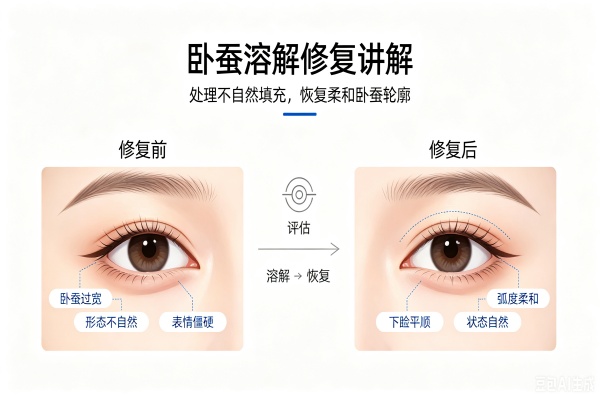
Don’t Panic If Your Aegyo-sal Went Wrong: Dissolving, Adjusting, and Repairing — A Complete Guide to Fixing It
As aegyo-sal injection popularity rises, so does the failure rate. A quick online search reveals countless cases: “aegyo-sal became eye bags,” “caterpillar under the eye,” “fish eyes when smiling.”
HA’s advantage is “reversibility” — if it goes wrong, it can be dissolved. But not all aegyo-sal problems can be solved with dissolution. Fat-filled aegyo-sal and ADM-implanted aegyo-sal require completely different approaches.
First, Identify Your Failure Type
Aegyo-sal injection “failure” usually isn’t infection or serious complications, but “wrong shape.” Here are the most common types.
【Cord-like ridge — “Caterpillar”】
The aegyo-sal becomes a clearly defined, stiff “strip,” especially obvious when smiling. Caused by too-superficial injection — HA didn’t spread at the orbicularis superficial layer but accumulated more superficially; or excessive single-point injection volume.
【Aegyo-sal displacement — Becoming eye bags】
The aegyo-sal disappears, replaced by a lower-positioned bulge. Caused by wrong injection position — HA was placed at the tear trough, or migrated downward due to gravity. The bulge is more obvious when smiling, completely becoming eye bags.
【Transparency and blue tint — Tyndall effect】
In sunlight or bright light, a blue-green halo appears under the eye. Because under-eye skin is extremely thin, using unsuitable HA (large molecule or high cross-linking) causes light scattering. Not painful, but very unsightly.
【Asymmetry — Obvious difference between sides】
Inconsistent shape, size, or position between left and right aegyo-sal. Unilateral dosage deviation, different injection depths, or different swelling levels. Some early asymmetry is normal, but if still obvious after 2 weeks, it’s a failure.
【Hard lumps or granular feeling】
Subcutaneous hard nodules or granules felt by touch, may not be visually obvious. Caused by uneven injection or localized HA accumulation.
How to Determine Repair: First Check Material, Then Method
The first step isn’t finding a doctor — it’s knowing what material was injected. Different materials require vastly different approaches.
【HA-filled aegyo-sal — Hyaluronidase is first choice】
Easiest to handle. Inject hyaluronidase; HA is dissolved within 24-48 hours, returning to original state. Temporary mild hollowing or unevenness may occur, naturally recovering in 1-2 weeks. Residual or asymmetry can be re-dissolved or re-injected.
【Autologous fat-filled aegyo-sal — Most challenging】
Once fat survives, it’s “your own tissue” — no drug can dissolve it. Mild issues can be adjusted with secondary fat grafting or laser lipolysis; severe hardening or abnormal shape requires surgical removal.
【ADM-implanted aegyo-sal — Requires surgical intervention】
ADM has integrated with tissue and can’t be dissolved. Unnatural shape or wrong position requires surgical removal or readjustment. Higher difficulty than initial implantation, demanding extreme surgical skill.
【Unknown material — Do examination first】
If unsure what was injected, high-frequency ultrasound or MRI is recommended to confirm material distribution and depth before planning.
Timing: Too Early or Too Late Both Inappropriate
【HA filling】: Can arrange hyaluronidase as soon as problems are noticed. Don’t “wait two more weeks” — over time, HA may spread or adhere to tissue, increasing treatment difficulty. Days 3-5 are observation; 7-14 days basically set. If shape is still unsatisfactory after two weeks, it’s time to act.
【Fat filling or ADM】: Wait 【3-6 months】 after initial surgery before considering repair. Give tissue time to stabilize, de-swell, and set. Premature intervention may lead to inaccurate assessment.
【Don’t rush】: Almost everyone has some swelling or unnaturalness in the first week. No treatment should be done at this stage — whether hyaluronidase or secondary surgery, wait until swelling fully subsides. Premature dissolution may disrupt the shape still in “break-in period.”
How Aegyo-sal Repair Surgery Works
【Hyaluronidase injection (for HA)】
Simplest repair. Doctor injects hyaluronidase into the aegyo-sal area; completed in minutes. HA dissolves within 24-48 hours. May accompany mild redness and swelling, subsiding in 1-2 days. Fine adjustment with HA re-injection if needed.
【Secondary fat grafting (for fat filling issues)】
For excessive fat or unsatisfactory shape. Doctor extracts small amounts of fat (from abdomen or thigh), purifies it, and uses fine needles for precise filling or aspiration adjustment. Minimal trauma, fast recovery, but requires precise fat survival prediction.
【Surgical removal (for ADM or severe hardening)】
Through internal lower eyelid or lash root incision, ADM or hardened tissue is removed. Relatively more trauma, 1-2 week recovery, possible mild scarring. Generally only considered when other methods fail.
【Laser lipolysis adjunct】: For mild unevenness after fat filling, laser lipolysis can fine-tune. Trauma level between injection and surgery.
Recovery After Repair
- 【Days 1-3】: Mild redness and swelling, mainly ice packs. Avoid rubbing injection area.
- 【1 week】: Most swelling subsides, hyaluronidase effects visible.
- 【2 weeks】: Shape basically stable, repair effect assessable.
- 【Post-repair restrictions】: Avoid strenuous exercise, sauna, alcohol for 1 week; don’t press or rub; keep clean.
What to Confirm Before Repair
During consultation, confirm: injected material (check medical records); review failure cause (dosage, depth, or position issue); clarify repair focus (dissolve and redo?局部 adjust? or remove?); assess achievable results (don’t expect “perfect restoration after repair”).
Aegyo-sal repair success rate is lower than initial injection because it involves both “correction” and “reshaping.” Good repair doctors don’t just “remove” — they reshape based on remaining material, which is harder than getting it right the first time. Setting reasonable expectations and patiently completing recovery is more important than rushing to “fix it all at once.”
Disclaimer: This article is compiled from public sources for reference only. Specific repair plans should be based on professional doctor consultation. This article does not constitute medical advice or a recommendation for any clinic or doctor.