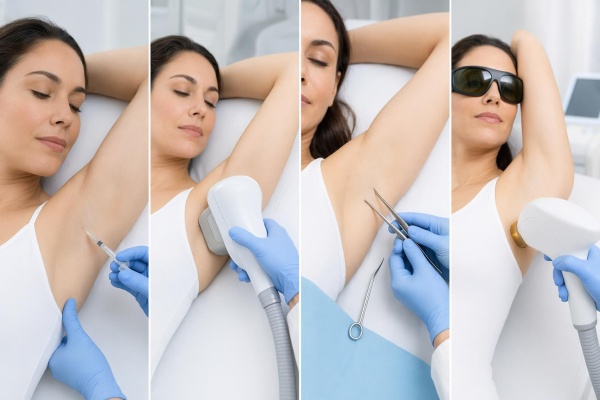
Surgical Underarm Odor Removal: Endoscopic Shaver, Curettage, and Fiber Optic Ablation — Korea’s Mainstream Techniques Compared
Most online information about underarm odor treatment stops at the “surgery vs. Botox vs. miraDry” comparison level. But once you decide to go the surgical route, many people still don’t know how to choose — some say minimally invasive techniques work better, some say endoscopy is more precise, and others vouch for fiber optic ablation’s faster recovery. For the same surgical underarm odor removal, incision lengths range from 3cm to 3mm, recovery times from 3 days to 4 weeks, and prices from a few thousand to tens of thousands. The difference isn’t in “whether surgery works” — it’s in which surgical logic you choose.
Surgical Underarm Odor Removal’s Core Logic: Not “Cutting Out” But “Clearing Out”
Many people think surgical underarm odor removal means “cutting out the skin under the armpit.” That was the traditional resection method — making a 3-4cm incision in the armpit and directly removing the entire patch of skin containing apocrine glands. The results are indeed the most thorough, but the trauma is significant, scarring is obvious, and recovery is long (2-4 weeks).
The logic of modern surgical underarm odor removal is completely different — 【it’s not about “removing skin” but “clearing out sweat glands”】. Through a small incision, without damaging the epidermis, the apocrine glands located in the deep dermis and superficial subcutaneous fat are cleaned out. The skin remains the same skin — only the “odor factory” inside has been dismantled.
This distinction matters: the former leaves behind 【a scar】, while the latter leaves behind 【an almost invisible mark】.
A Complete Breakdown of Korea’s Mainstream Surgical Techniques
- Endoscopic-Assisted Shaver Technique — The Most Precise Choice
Incision approx. 1cm · High-Definition Endoscopic Visualization · Powered Shaver for Precision Resection
Through a tiny 【1cm】 incision along the axillary crease, a 【high-definition endoscope】 is inserted to precisely locate the apocrine glands under magnified visualization. The surgeon clearly sees the position and morphology of the apocrine glands on the screen and uses a 【powered shaver】 (rotating at approximately 6,000r/s) to precisely excise them while suction removes the excised tissue.
【Technical Details:】 The procedure is performed under tumescent anesthesia. Tissue scissors perform blunt dissection at the superficial fascia layer, creating a skin flap with approximately 4-5mm of subcutaneous fat thickness. After the shaver excision, a curette is used to scrape residual gland tissue until the endoscopic view confirms the subdermal vascular network with no pink granular apocrine gland remnants. The incision is closed with 7-0 prolene suture.
【Clinical Data:】 A comparative study involving 358 patients (716 axillae) showed that the endoscopic group had shorter operative times and less blood loss. At 6-12 months follow-up, no recurrences were observed in any patient.
Reference Price: Approximately 8,000-15,000 RMB
- Small-Incision Curettage — The Most Cost-Effective Minimally Invasive Option
Incision 1-2cm · Curette Scraping · Blind Technique
The incision is approximately 【1-2cm】, and a curette is used to scrape and remove sweat glands under blind (non-visualized) conditions. The procedure is relatively simple, requiring no endoscopic equipment, at a lower cost.
【Technical Details:】 Also performed under tumescent anesthesia. After blunt dissection at the superficial fascia layer, subcutaneous tissue, hair follicles, and apocrine gland bodies are trimmed flush against the dermal layer, converting the skin flap into a full-thickness skin graft. Residual glands are then scraped with a curette, complete hemostasis is achieved, and the area is repeatedly irrigated with saline.
【Clinical Data:】 The incision is similarly closed with 7-0 prolene suture. The endoscopic group had shorter operative time and less blood loss than the small-incision group. However, postoperative recovery times were roughly similar between the two.
Reference Price: Approximately 5,000-8,000 RMB
- Fiber Optic Ablation + Curettage — The Most Minimally Traumatic Innovative Technique
Incision approx. 0.3-0.5mm · Laser/Radiofrequency Energy · Scar-Free Recovery
An ultra-fine fiber optic probe (diameter approximately 【0.3-0.5mm】) is inserted percutaneously, using laser or radiofrequency energy to selectively destroy sweat gland tissue, followed by curette removal of remnants.
【Clinical Data:】 A study involving 38 patients (76 axillae) showed that after combined fiber optic ablation and curettage, 【81.58% of patients met the cure criteria】, 10.53% showed significant improvement, 5.26% showed effectiveness, and only 2.63% showed no effect. The postoperative complication rate was only 【2.63%】, recurrence rate was 【2.63%】, and patient satisfaction reached as high as 【94.74%】.
Reference Price: Approximately 1.5-3 million KRW in Korea (approx. 8,000-16,000 RMB)
- SURE Technique — Korea’s Combined Approach
Four-Step Integration · Ultrasound-Assisted Liposuction · Endoscopic Exploration
Korea’s Silhouette Plastic Surgery integrates four techniques into a single procedure: 【Pre-curettage】 to create the skin flap plane → 【Ultrasound-Assisted Liposuction】 to emulsify subcutaneous fat → 【Post-curettage】 dermal scraping → 【Endoscopic Exploration】 to remove residual apocrine glands under visualization.
In 43 patients followed up for 3-12 months, 【overall satisfaction was 91%】. The complication rate (skin sloughing and subcutaneous banding) was 14%, but all were temporary and resolved completely without special intervention.
Reference Price: By consultation only, generally higher than single-technique procedures
Comparison of Three Techniques
| Comparison Dimension | Endoscopic Shaver | Small-Incision Curettage | Fiber Optic Ablation + Curettage |
|---|---|---|---|
| Incision Size | Approx. 1cm | 1-2cm | Approx. 0.3-0.5mm |
| Visualization | HD Endoscopic | Blind | Blind + Energy-Assisted |
| Precision | Highest | Moderate | High |
| Recovery Period | 1-2 weeks | 1-2 weeks | 3-7 days |
| Scarring | Barely Visible | Fairly Concealed | Virtually Scar-Free |
| Price (RMB) | 8,000-15,000 | 5,000-8,000 | 8,000-16,000 |
| Recurrence Rate | Extremely Low | Low | Approx. 2.6% |
The Real Recovery Experience
- 【Post-Op Day 1-3:】 Underarm swelling and mild pain. Elastic bandage compression is required, the arm cannot hang fully down and must be maintained at least at a 45-degree angle. Upper limb movement is restricted for 72 hours post-op. Ice pack cold compresses are recommended to reduce swelling.
- 【Post-Op Day 4-7:】 Swelling gradually subsides. Keep the dressing dry and avoid getting it wet.
- 【Post-Op Week 1-2:】 The wound is basically healed. Avoid strenuous exercise for 2 weeks post-op, and do not use antiperspirants for 1 month. Sutures are removed around day 12.
- 【Post-Op Month 1-3:】 The scar gradually fades, and the result stabilizes.
The Truth About Surgical Recurrence
Clinical data shows that standardized surgery can remove over 80% of apocrine glands, with 【a recurrence rate below 5%】. A study involving 588 patients followed for 10-15 years showed that 【77.4% had good results, 19.5% had moderate results, and only 3.1% experienced recurrence】.
Main causes of recurrence: Incomplete clearance of apocrine glands (insufficient surgical range or suboptimal technique); postoperative lifestyle factors (strenuous exercise, spicy food intake stimulating sweating). Choosing an experienced surgeon and a standardized technique is key to minimizing the recurrence rate.
【How to Choose — Match Your Needs:】
- 【Pursuing highest precision, accepting higher cost】 → 【Endoscopic Shaver Technique】. Operates under high-definition visualization, most thorough clearance, lowest recurrence rate.
- 【Pursuing cost-effectiveness, moderate-to-severe axillary osmidrosis】 → 【Small-Incision Curettage】. Proven results, moderate cost, concealed scarring.
- 【Pursuing minimal trauma, fastest recovery】 → 【Fiber Optic Ablation + Curettage】. Minimal incision, short recovery, high satisfaction.
- 【Ample budget, pursuing the most comprehensive approach】 → Consult with Korean clinics about SURE Technique and other combined approaches.
Surgical underarm odor removal is not “one method for everyone.” Your severity of axillary osmidrosis, budget, and tolerance for scarring and recovery time — these three variables determine which technique suits you best. A doctor who can explain the surgical logic clearly is more trustworthy than one who only quotes the lowest price.
【Disclaimer:】
The information in this article is compiled from publicly available clinical research and industry reports for reference only. Specific surgical technique selection and costs should be based on a professional in-person consultation with a physician. This article does not constitute medical advice or endorsement of any technique or brand.