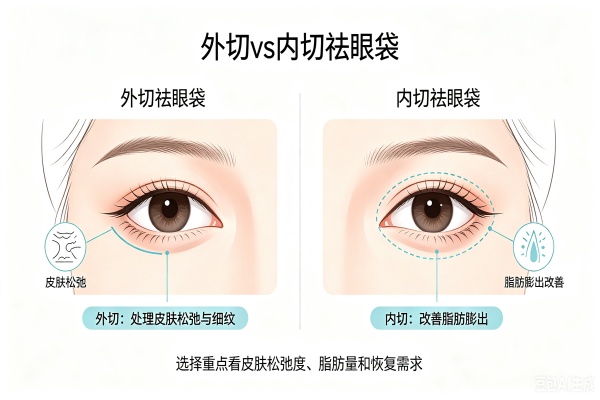
Internal vs. External Incision Eye Bag Surgery: Korean Doctors’ Incision Selection Logic Is Different from What You Think
The most common confusion about eye bag surgery is “should I choose internal or external incision?” Many think it’s simply about “where the cut is” and mainly about scar fear. This understanding isn’t wrong, but it’s too superficial.
The essential difference between internal and external incision 【isn’t where the cut is, but what problems it can solve.】 Korean doctors use more refined criteria than you’d expect — not simply by age, but comprehensively considering fat volume, tear trough depth, and skin laxity.
The Essential Surgical Difference
【Internal incision (transconjunctival)】: The incision is on the inner conjunctival surface of the lower eyelid — the red part seen when you pull down the lower lid. Through this tiny incision, orbital fat is precisely handled — partially removed or flattened into tear trough hollows.
【External incision (transcutaneous)】: The incision is at the lower eyelid lash line (1-1.5mm below the lash margin). Through this incision, not only fat but also loose orbicularis muscle can be lifted and excess skin excised.
Korean dermatologists typically use absorbable sutures to reinforce the orbital septum after fat release/removal. External incision also involves superficial suspension of skin and muscle, providing some midface lift.
Completely Different Suitable Candidates
【Internal incision suits】: Younger patients with only orbital fat bulging, 【no skin laxity.】 Key characteristics: obvious fat bulging but firm skin, few wrinkles. Typically under 40, or older but with well-maintained eye area skin.
【External incision suits】: Those with orbital fat bulging 【accompanied by skin laxity.】 Key characteristics: loose lower eyelid skin, obvious wrinkles, prominent bulging. If this describes you, internal incision isn’t suitable — it can’t remove loose external skin, leaving sagging skin after fat removal.
Korean doctors use a more refined criterion: 【tear trough depth】 and 【orbital fat volume.】 If tear troughs are shallow with moderate fat, internal fat repositioning suffices; if deep with insufficient fat, supplemental fat grafting may be needed; if skin elasticity is poor with obvious under-eye lines, external incision is the right choice.
Pros and Cons Comparison
| Dimension | Internal | External |
|---|---|---|
| Incision location | Inner conjunctival surface | Lower lash line |
| External scars | None | Yes (fades with fine suturing) |
| Problems solved | Only fat bulging | Fat + skin laxity + muscle laxity + wrinkles |
| Surgical trauma | Small, relatively simple | Large, multi-layer tissue |
| Recovery time | 1-2 weeks basically natural | 1-3 months fully natural |
| Complication risk | Low risk of ectropion/eyelid retraction | Possible ectropion, hollowing |
| Duration | 5-10 years | 10+ years |
| —— |
Recovery Differences
【Internal incision】: Basically de-swelled in 【1 week】, naturally recovered in 2-3 weeks. Incision inside conjunctiva, no suture removal. Most return to normal life in 【3-7 days.】 Korean clinics apply ice packs for 2 hours post-op to control hematoma.
【External incision】: Suture removal in 【1-2 weeks】, basically de-swelled in 2-4 weeks, fully natural in 【1-3 months.】 Mild soreness for 24 hours. Korean doctors recommend avoiding contact lenses for 【1 month】 after external incision.
Price Reference
- 【Internal incision】: ~【1M-2M KRW】 (~5,300-10,600 RMB). For simple fat bulging with good skin elasticity.
- 【External incision】: ~【2M-4M KRW】 (~10,600-21,000 RMB). For skin laxity with fat bulging.
These are basic reference prices. If simultaneous orbital fat release (fat repositioning for tear troughs) is needed, costs increase accordingly.
How to Judge Which Suits You
【The core criterion is simple: is your under-eye skin loose?】
If you’re young with firm skin and only fat bulging — 【internal incision】 is more suitable. If you’re older with obviously loose lower eyelid skin, many wrinkles, and sagging — 【external incision】 is more suitable.
【Important reminder】: Internal and external are simply different approaches for different eye bag conditions. Neither is inherently better — they suit different people. Online claims that “internal is better than external” are essentially comparing apples to oranges.
The final result depends not only on your choice of internal vs. external, but on the surgeon’s comprehensive judgment of fat volume, skin laxity, and orbital structure. Korean plastic surgeons assess not only eye bag type but also check 【tear trough ligament tension】, 【orbicularis muscle strength】, and 【aegyo-sal (love band) shape】. The best approach is to visit a legitimate clinic for professional assessment.
Disclaimer: This article is compiled from public sources and industry reports for reference only. Specific treatment plans and costs should be based on professional doctor consultation. This article does not constitute medical advice or a recommendation for any clinic or doctor.