Tear Trough Eye Bags: How to Improve Them by First Distinguishing Bulge from Depression
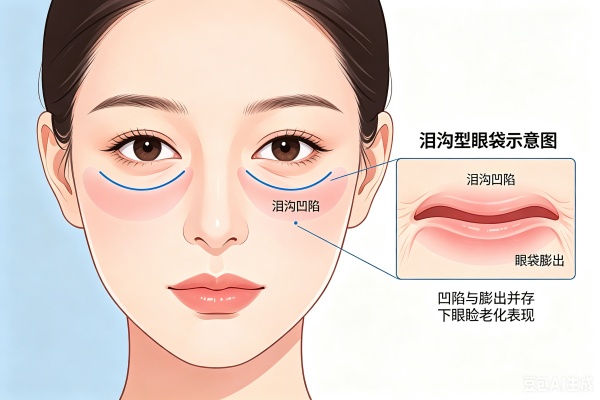
Those two grooves under your eyes — concealer can’t hide them, filters can’t smooth them, and bare face looks tired and haggard. Many think they’re eye bags, only to discover during consultation that 【eye bags bulge outward while tear troughs indent inward】.
The tear trough, also called the palpebromalar groove, is a depression extending from the inner eye corner along the lower eyelid toward the nose. Eye bags are pouch-like protrusions from orbital fat herniation. They often coexist — the more prominent the eye bags, the deeper the tear troughs appear. Medically, this is called the 【”eye bag-tear trough complex”】.
If you have both eye bags and tear troughs, simply cutting eye bags or filling tear troughs alone may yield suboptimal results. 【How to improve tear trough eye bags depends on which type you have.】
Causes of Tear Trough Eye Bags
Tear troughs are normal physiological structures — depth varies by individual. They become prominent for two main reasons.
【Congenital factors:】 A dense connective tissue — the 【orbicularis oculi supporting ligament】 — lies deep beneath the tear trough, acting like a “rope” anchoring the skin. Those with strong ligaments are more prone to skin traction forming depressions. This is why some young people with firm skin and no eye bags still have faint tear troughs.
【Acquired factors:】 With age, periocular skin thins, subcutaneous fat atrophies, and collagen depletes. The ligament doesn’t change, but surrounding tissue thins and descends, deepening the once-subtle groove. Combined with orbital septum laxity causing fat protrusion, the height difference between bulge and depression makes tear troughs appear deeper.
Three Types of Tear Trough Eye Bags
Korean doctors typically classify tear trough issues into three types based on eye area assessment.
【Young-type tear trough:】 Common in young people. Orbital rim is full, skin is firm, no eye bags. Depression forms purely because the tear trough ligament is too tight, pulling the skin. These people look like they have dark circles no matter how well they rest.
【Eye bag-type tear trough:】 The most common type. With age, the orbital septum loosens and fat protrudes forming eye bags, while tissue below is relatively empty — the height difference deepens the tear trough. Creates a noticeably aged, haggard appearance.
【Aging-type tear trough:】 Tear trough depression + cheek descent + facial volume loss occur simultaneously. The tear trough extends downward, connecting with nasolabial folds, creating uneven facial contours with obvious signs of aging.
Three Situations, Three Solutions
- Mild to Moderate Tear Trough, No Eye Bags — Fillers
For pure tear trough depression without visible eye bags, fillers are the most direct approach.
【Hyaluronic acid filler:】 Small-molecule HA injected into the depression to restore volume. Advantages: 【immediate results, short recovery (1-2 weeks)】. Tear trough skin is thin — must use soft, fine small-molecule HA injected precisely by experienced doctors to avoid the “Tyndall effect” (local bluish discoloration). Results last approximately 【1 year】 before absorption.
【Collagen filler:】 Suitable for those with concurrent vascular dark circles — milky white texture conceals discoloration. Minimal trauma but shorter duration than HA.
【Autologous fat transfer:】 For deeper depressions seeking long-term results. Fat survival provides lasting effects, but requires liposuction and typically multiple sessions.
- Eye Bags + Tear Trough Coexisting — Orbital Fat Repositioning
When both exist simultaneously, simply filling the tear trough may make eye bags more prominent. 【Orbital fat repositioning】 is more appropriate.
This procedure preserves the protruding eye bag fat during eye bag removal surgery and 【relocates it to the tear trough depression】. One surgery addresses both “bulge” and “depression.” Results are long-lasting, avoiding the hassle of repeated injections.
Surgical approaches include 【internal incision】 (transconjunctival, no external scar) or 【external incision】 (transcutaneous, can simultaneously remove loose skin). Suitable for those with visible eye bags and deep tear troughs. Note: if tear troughs are very deep but eye bags aren’t significant, fat repositioning may not be suitable — insufficient fat to transfer.
- With Fine Lines or Skin Laxity — Combination Treatment
If tear troughs come with periocular fine lines or skin laxity, consider RF treatments (like Thermage) first to tighten the eye area, then fill with minimal material.
| Tear Trough Type | Recommended Option |
|---|---|
| Pure tear trough, no eye bags | HA/collagen/autologous fat filler |
| Tear trough + eye bags | Orbital fat repositioning (solves both) |
| Tear trough + fine lines/laxity | RF tightening + filler combination |
Daily Care for Tear Trough Eye Bags
Medical treatment is the core for improvement. Daily care cannot eliminate structural tear troughs but can slow progression:
- Ensure adequate sleep, avoid chronic late nights
- Reduce sodium intake to prevent fluid retention worsening puffiness
- Use eye skincare with vitamin C, retinol to enhance skin elasticity
- Maintain periocular hydration and strict sun protection
The core logic for improving tear trough eye bags: 【classify first, then choose the method.】
- 【Pure tear trough, no eye bags】 → HA/collagen/autologous fat filler
- 【Tear trough + eye bags】 → Orbital fat repositioning (solves both at once)
- 【Tear trough + fine lines/laxity】 → RF tightening + filler combination
If you’re still unsure which type you have, having a doctor assess your tear trough classification, eye bag severity, and skin condition during consultation is more useful than reading a hundred online guides.
Disclaimer: This article is for educational purposes only. Specific treatment plans should be determined by a professional doctor through in-person consultation.